


Phone:
+86 138 0927 7026


Views: 266 Author: Tianhai Leather Publish Time: 2026-11-16 Origin: Site


Content Menu
● Microfiber Leather vs Nappa PU: Understanding the Real Difference
>> What Is Microfiber Leather?
● Microfiber Leather vs Nappa PU Steering Wheel Covers: Comparison Table
● Which Material Performs Better in Everyday Driving?
>> Grip: Separate Hand Traction from Cover Slippage
>> Durability: Examine More Than Abrasion Resistance
>> Comfort: Evaluate the Finished Assembly
● Three Overlooked Factors That Change the Buying Decision
>> 1. Humidity Aging Deserves Its Own Approval Gate
>> 2. Hand Products and Cleaners Belong in the Test Plan
>> 3. Total Conversion Cost Matters More Than Price per Meter
● A Practical Testing Plan for Automotive Steering Wheel Cover Materials
● How to Choose the Right Material in Five Steps
>> Step 1: Define the Cover and Vehicle Application
>> Step 2: Request Two Comparable Constructions
>> Step 3: Establish Pass/Fail Requirements
>> Step 4: Build and Evaluate Prototypes
>> Step 5: Retain an Approved Reference
● Why Choose Tianhai for Custom Synthetic Leather Development?
● FAQs About Microfiber Leather and Nappa PU Steering Wheel Covers
>> Is microfiber leather better than Nappa PU for steering wheel covers?
>> Can microfiber leather have a Nappa finish?
>> Is Nappa PU genuine leather?
>> Which option is less likely to peel?
>> Which material is easier to clean?
>> Can either material be used with a heated steering wheel?
● Start Your Steering Wheel Cover Material Project
At Tianhai Leather (Dongguan) Co., Ltd., we develop and manufacture synthetic leather for automotive interiors, marine upholstery, furniture, footwear, and bags, with small-batch customization available. When customers ask, "Microfiber Leather vs Nappa PU: Which Is Better for Steering Wheel Covers?", our recommendation is to compare the complete material construction—not just its name.
Microfiber-backed synthetic leather is worth evaluating when structural stability and stitching performance are priorities. Nappa-style PU deserves consideration when softness, fine grain, and a premium appearance lead the brief. However, neither label guarantees better grip, longer life, or automotive suitability.
The most important detail is often overlooked: microfiber leather can also have a Nappa-style finish. Your ideal solution may combine both.
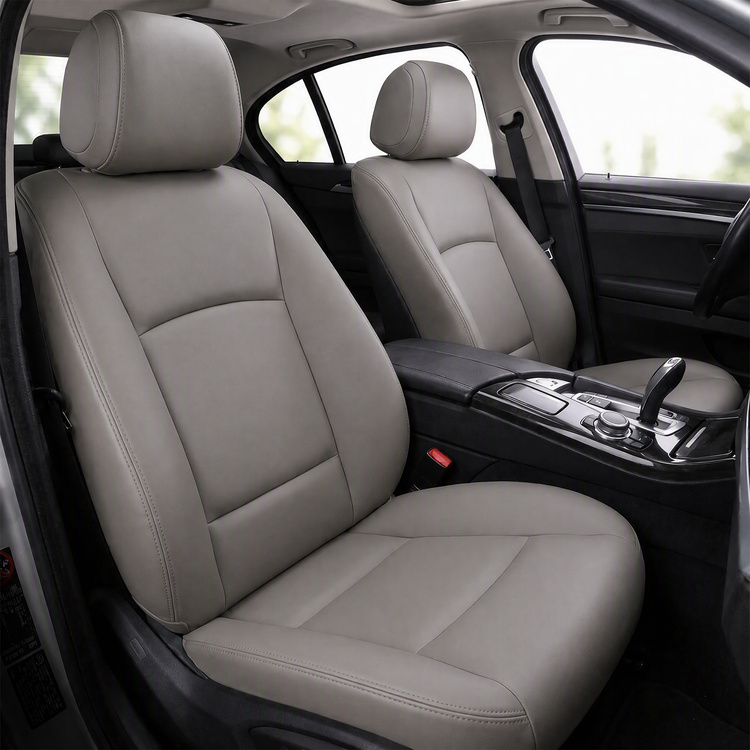
This comparison mixes two different ways of describing synthetic leather: its internal construction and its surface character.
Microfiber synthetic leather typically combines an ultrafine-fiber nonwoven substrate with polyurethane. Its fiber network provides the underlying structure, while the polyurethane system and surface treatment influence appearance, touch, and performance.
For steering wheel covers, buyers should examine:
- Resistance to stretching during installation.
- Tear strength around stitch holes.
- Flexibility around tight curves.
- Coating adhesion and surface wear.
- Consistency between production batches.
A microfiber backing can be a useful starting point, but the finished composite still needs testing. A strong substrate cannot compensate for an unsuitable surface coating.
"Nappa PU" is commonly used commercially for polyurethane synthetic leather with a soft touch and a fine, leather-like grain.
It is not a standardized performance grade. The name alone does not identify the backing, coating thickness, resin chemistry, or durability.
Nappa-style PU may use a knitted, woven, or microfiber substrate. Consequently, two materials sold under the same name can behave very differently during cutting, sewing, installation, and use.
Ask suppliers what is underneath the finish before comparing quotations.
For purchasing purposes, the table below compares microfiber-backed synthetic leather with Nappa-style PU on a conventional textile backing. These are evaluation priorities, not guaranteed rankings.
| Selection factor | Microfiber-backed synthetic leather | Nappa-style PU on textile backing |
|---|---|---|
| Main characteristic | Engineered microfiber substrate | Soft, fine-grain surface presentation |
| Touch | Depends on resin, finish, and backing | Usually marketed for supple hand feel |
| Stitching performance | Evaluate stitch-hole strength and tear resistance | Evaluate backing strength and seam distortion |
| Installation behavior | Check controlled stretch and recovery | Check stretch direction and residual deformation |
| Surface durability | Depends heavily on coating formulation | Depends heavily on coating formulation |
| Grip | Must be assessed on the finished cover | Must be assessed on the finished cover |
| Cost comparison | Compare equivalent specifications and usable yield | Compare equivalent specifications and usable yield |
| Best purchasing approach | Validate construction and finished-cover performance | Verify what the Nappa label actually includes |
Our selection principle is straightforward: construction first, surface preference second, and approval through testing.
A steering wheel cover is a repeated-contact component. Material selection must account for hands, friction, contamination, cleaning, and the vehicle environment.
There are two different grip questions:
1. Do the driver's hands maintain suitable traction on the outer surface?
2. Does the cover remain securely positioned on the steering wheel?
The first concerns texture, finish, contamination, and hand conditions. The second concerns dimensions, lining, installation, and assembly design.
A soft surface is not automatically slippery. A deep grain is not automatically secure.
Evaluate both candidates on the same wheel geometry under dry and damp-hand conditions. Check for independent movement of the cover, especially after repeated handling.
Do not approve a cover that rotates or shifts independently during evaluation.
Abrasion testing measures one part of durability. It does not independently establish resistance to humidity, cleaners, seam stress, or coating separation.
For microfiber leather steering wheel covers, inspect both the substrate and the finish.
For Nappa PU steering wheel covers, pay particular attention to whether the desired soft touch remains acceptable after conditioning and cleaning.
The useful question is not simply, "Which material resists more rubbing?"
It is, "Which complete construction retains its appearance, integrity, and fit under our defined conditions?"
A flat swatch cannot fully represent an installed cover.
Backing thickness, foam, seams, perforation, and wheel diameter all influence perceived comfort. A luxurious sample may become too bulky after assembly. A firmer sample may feel more controlled once wrapped correctly.
Compare finished prototypes, not isolated hand-feel samples.
PU-containing materials require attention to aging behavior. Initial appearance and abrasion results do not establish how the material will perform after prolonged environmental exposure.
Ask the supplier or laboratory to define:
- The conditioning method.
- Temperature, humidity, and exposure duration.
- The properties checked after exposure.
- Acceptance limits for cracking, tackiness, peeling, and strength changes.
Accelerated aging is a comparative tool. It should not be converted into a guaranteed number of service years without a validated correlation.
Steering wheel covers may encounter perspiration, skin oils, sunscreen, hand cream, and cleaning products.
Create a chemical-exposure list that reflects the intended customer and market. Evaluate visible changes, color transfer, surface tack, and coating integrity after the agreed procedure.
Avoid assuming that "easy-clean" means compatibility with every cleaner. Confirm care instructions using the actual material.
This step helps turn a broad marketing claim into a practical maintenance specification.
A lower material quotation does not necessarily produce a lower-cost cover.
Compare:
- Usable cutting yield.
- Backing consistency and directional stretch.
- Sewing speed and seam appearance.
- Rework during installation.
- Rejected pieces and replacement costs.
A material that costs more initially may be commercially attractive if it improves conversion consistency. That outcome must be demonstrated through your own trial production—not assumed from the material category.
At Tianhai, our recommended buying approach is to agree on measurable requirements before approving appearance.
The following framework can guide discussions with a qualified laboratory. Method suitability and acceptance criteria must match the actual construction and customer specification.
| Evaluation area | Purpose | What to request |
|---|---|---|
| Abrasion | Compare surface wear | Method, load, abrasive, cycles, and failure definition |
| Accelerated aging | Examine environmental deterioration | Exposure conditions and post-aging results |
| Light exposure | Evaluate appearance changes | Exposure procedure and color-change assessment |
| Tear and seam performance | Assess assembly robustness | Specimen direction, stitch details, and failure mode |
| Chemical resistance | Evaluate contact with selected substances | Chemical list, dwell time, and assessment criteria |
| Interior emissions | Characterize relevant organic emissions | Applicable method, sample preparation, and results |
| Burning behavior | Address applicable interior-material requirements | Relevant test method and customer acceptance criteria |
For coated fabrics, ISO 5470 provides abrasion-test methods, while ISO 1419 addresses accelerated aging. SAE J2412 describes controlled xenon-arc exposure for automotive interior trim.
ISO 3795 addresses horizontal burning behavior of interior materials. ISO 12219-11 describes an analytical approach for characterizing organic emissions from non-metallic vehicle materials.
These are test methods, not automatic product certifications. A statement such as "tested to ISO" is incomplete without the method, conditions, results, and acceptance requirements.
Specify whether the product is a stitched wrap or a slip-on cover. Record wheel geometry, rim dimensions, installation method, and target market.
Where heating or hands-on detection is present, confirm compatibility against vehicle-manufacturer requirements. Do not assume that a cover is suitable because it fits physically.
Compare samples with similar thickness, color, surface texture, and intended application.
Otherwise, a preference attributed to "microfiber versus PU" may actually reflect different coatings or backing weights.
Agree on appearance, mechanical performance, environmental conditioning, and installation criteria before testing.
Avoid selecting whichever sample merely feels better during the first meeting.
Use the intended thread, stitch pattern, lining, and installation process.
Record wrinkles, seam opening, stretching, surface changes, and movement on the wheel. Repeat critical checks after conditioning.
Keep an approved physical sample together with its material specification and inspection criteria.
This creates a clearer basis for checking later production than photographs or descriptive terms such as "premium softness."
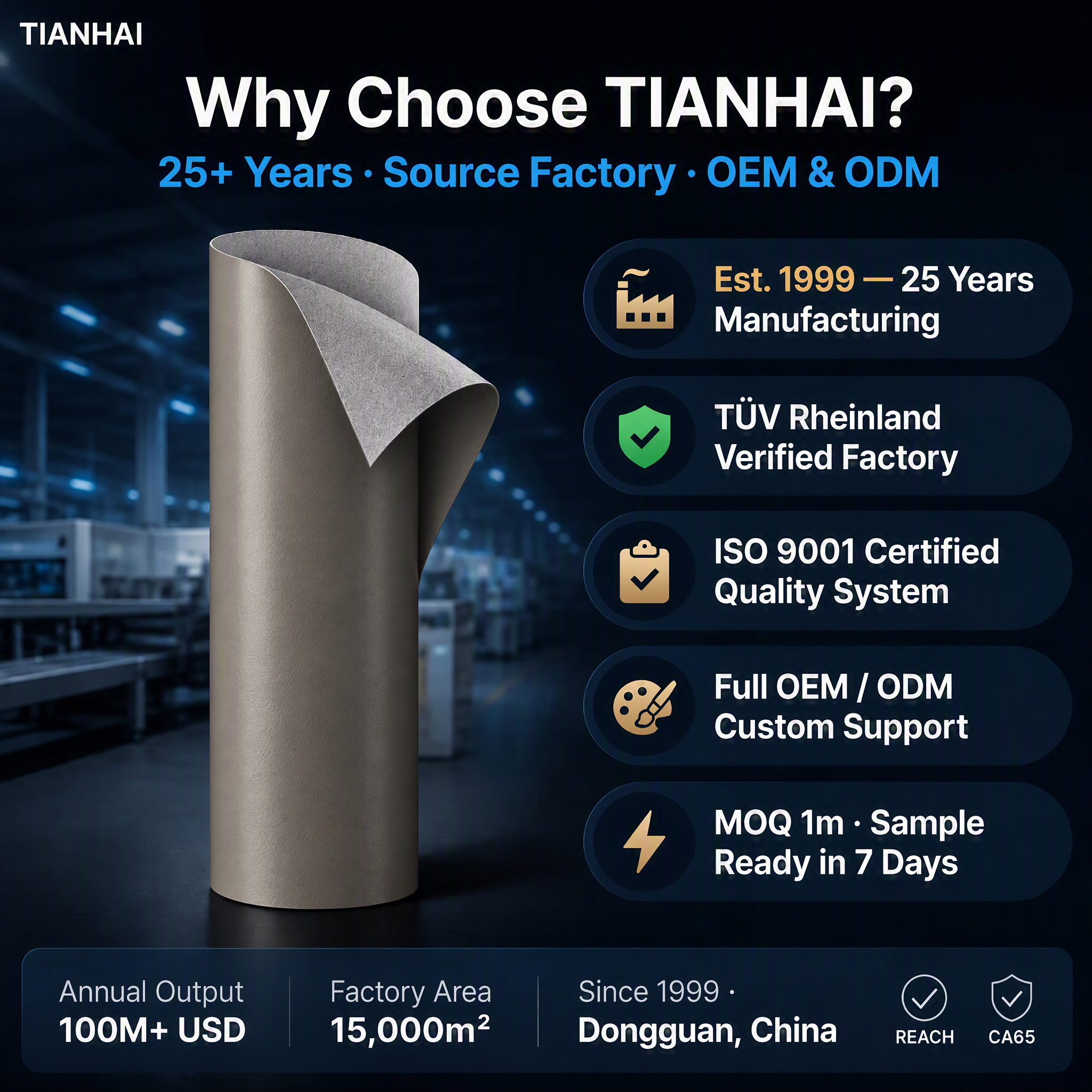
Tianhai Leather (Dongguan) Co., Ltd. focuses on synthetic leather research, manufacturing, and customization across multiple application sectors.
For steering wheel cover projects, our small-batch customization approach gives buyers a way to explore material options before committing to larger production quantities.
Start the discussion with your target grain, color, hand feel, backing, thickness, quantity, and required performance.
Our recommended priority is verified suitability rather than an impressive material label. Automotive, marine, furniture, footwear, and bag applications have different demands; suitability in one application should not be treated as proof of suitability in another.
Environmental requirements also need precise definitions. "Synthetic," "animal-free," and "eco-friendly" are not interchangeable claims. Specify the restricted substances, emissions, recycled content, or other attributes you need, then request supporting documentation.
Not automatically. Microfiber backing is worth evaluating for structural requirements, while Nappa-style PU emphasizes surface character. The better choice is the construction that passes your agreed performance and installation criteria.
Yes. Microfiber describes the substrate construction, while Nappa-style describes the intended surface appearance and feel. One product can combine both.
No. Nappa PU refers to polyurethane synthetic leather marketed with a Nappa-like appearance or touch. It should not be confused with genuine Nappa leather.
The category name cannot answer that reliably. Compare coating adhesion, aging behavior, formulation, and relevant test results for the specific materials.
Cleanability depends on the finish and the substance being removed. Request validated care instructions and evaluate the intended cleaners before approval.
Potential compatibility must be assessed for the particular vehicle and finished cover. Confirm manufacturer requirements and evaluate the complete assembly rather than assuming that either material name guarantees suitability.
Choose microfiber-backed synthetic leather when its construction best supports your requirements. Choose Nappa-style PU when its surface character fits the design—and its supporting construction passes validation.
Or evaluate microfiber leather with a Nappa-style finish.
Contact Tianhai Leather (Dongguan) Co., Ltd. with your wheel dimensions, cover design, target quantity, preferred finish, and testing requirements. Request a tailored sample discussion and define an approval plan before placing a production order.
1. Tianhai Leather (Dongguan) Co., Ltd. — Company information supplied in the project brief. Source for business scope and small-batch customization positioning. No public company page or customer reviews were supplied.
2. Waltery — "What Is Microfiber Synthetic Leather?" Commercial technical background on microfiber nonwoven substrates, PU construction, and Nappa-style finish options. Not an independent product-performance comparison. [walterychina]
3. International Organization for Standardization — "Coated Fabrics," classification 59.080.40. Standards catalogue covering ISO 1419 accelerated-aging methods and ISO 5470 abrasion methods. [iso]
4. SAE International — "SAE J2412_202402: Accelerated Exposure of Automotive Interior Trim Components Using a Controlled Irradiance Xenon-Arc Apparatus." Published February 23, 2024. [saemobilus.sae]
5. International Organization for Standardization — "ISO 3795:1989: Road Vehicles, and Tractors and Machinery for Agriculture and Forestry—Determination of Burning Behaviour of Interior Materials." [iso]
6. International Organization for Standardization — "ISO 12219-11:2025: Interior Air of Road Vehicles—Part 11." Analytical method addressing organic emissions from non-metallic vehicle materials. [iso]
7. Assured Testing Services — "Abrasion and Wear." Background on controlled abrasion evaluation for automotive interior components, including steering wheel wrapping materials. [assuredtesting]
Hot Tags: China, Global, OEM, private label, manufacturers, factory, suppliers, manufacturing company
