


Phone:
+86 138 0927 7026


Views: 229 Author: Tianhai Leather Publish Time: 2026-11-17 Origin: Site


Content Menu
● PU Leather vs Microfiber Leather for Automotive Seats in Hot Climates: The Essential Difference
● Why Hot Climates Challenge Automotive Seat Materials
>> Solar Heating and Contact Comfort Are Different Problems
>> Hot-Dry and Hot-Humid Conditions Need Different Priorities
● Which Material Feels Cooler in Summer?
>> Compare Like-for-Like Samples
● Breathability: Evaluate the Entire Seat Construction
>> Perforation Is Only One Part of the System
● Hydrolysis Resistance: The Critical Check for Hot-Humid Markets
>> Inspect More Than Surface Appearance
● A Practical Validation Plan Before Production
>> Step 1: Define the Use Case
>> Step 2: Review Comparable Test Reports
>> Step 3: Test Realistic Contaminants
>> Step 4: Build and Assess a Prototype
● Odor, VOCs, and Fogging: Separate the Requirements
● An Illustrative Selection Scenario: Two Markets, Different Decisions
>> Project A: A Hot-Dry Custom Interior
>> Project B: A Hot-Humid Fleet Application
● Environmental Claims: Ask What Is Being Measured
● Small-Batch Customization with Tianhai Leather
>> Is microfiber leather better than PU leather for hot climates?
>> Does microfiber leather stay cooler in direct sunlight?
>> Can microfiber leather peel?
>> Is PU leather suitable for ventilated automotive seats?
>> How long will synthetic automotive leather last?
>> What should I send Tianhai Leather when requesting samples?
● Start Your Automotive Upholstery Project
At Tianhai Leather (Dongguan) Co., Ltd., we develop, manufacture, and customize synthetic leather for automotive interiors, marine seating, furniture, footwear, and bags. When discussing PU leather vs microfiber leather for automotive seats in hot climates, our starting point is simple: choose a verified material construction, not just a category name.
Neither option automatically stays cooler, resists peeling longer, or provides better comfort. Performance depends on polyurethane chemistry, backing structure, surface finish, color, and the complete seat assembly.
This guide explains how to compare both materials, avoid misleading claims, and develop a practical specification for your next automotive upholstery project.
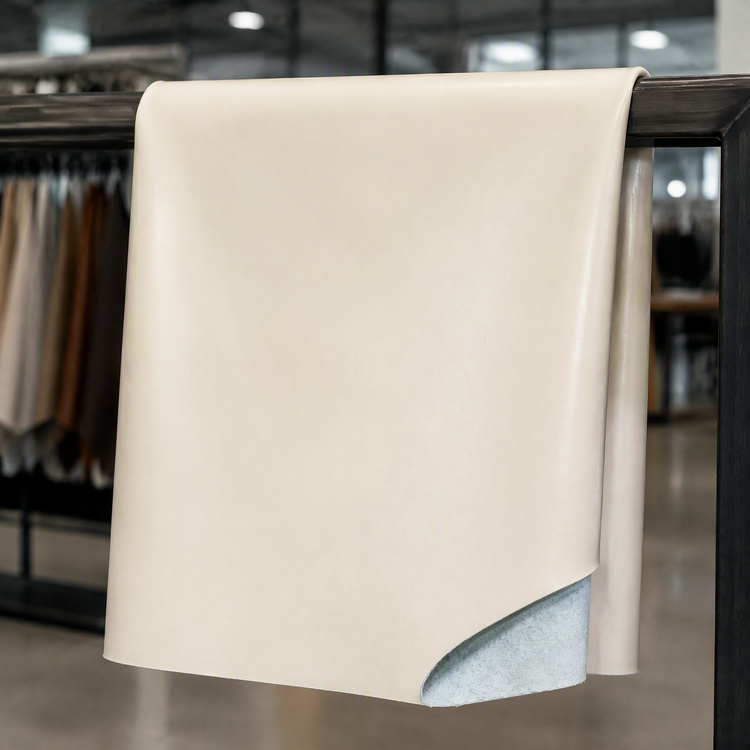
The terminology can be confusing because microfiber leather often contains polyurethane too.
For this comparison, conventional PU leather means a polyurethane-coated material supported by a textile backing. Microfiber leather means a synthetic leather built around an ultrafine-fiber nonwoven structure, typically combined with polyurethane.
In other words, this is usually a comparison between constructions—not polyurethane versus a completely different polymer.
| Selection factor | Conventional PU leather | Microfiber leather |
|---|---|---|
| Basic construction | PU coating on a textile backing | Ultrafine-fiber nonwoven structure combined with PU |
| Main selection opportunity | Tailoring surface finish, flexibility, and backing | Tailoring fiber structure, body, and mechanical behavior |
| Hot-touch comfort | Requires finished-surface testing | Requires finished-surface testing |
| Heat-and-humidity durability | Depends on the complete formulation | Also depends on the complete formulation |
| Breathability | Must be demonstrated | Must be demonstrated |
| Purchasing decision | Compare qualified grades and total cost | Compare qualified grades and total cost |
Our recommendation is to compare shortlisted grades under the same conditions. A category label cannot replace a technical specification.
Sunlight heats interior surfaces. Once a passenger sits down, comfort also depends on how the upholstery exchanges heat and manages moisture at the body–seat interface.
A material can feel comfortable in an air-conditioned showroom yet become unpleasant after outdoor parking.
For that reason, evaluate two separate questions:
- How hot does the finished seat surface become after solar exposure?
- How comfortable does the seat remain during sustained contact?
Record surface temperature separately from cabin air temperature. They are not interchangeable measurements.
A hot-dry application should emphasize solar exposure, thermal aging, surface appearance, and cleaning compatibility.
A hot-humid application adds another concern: moisture-driven degradation within susceptible polyurethane systems.
Hydrolysis can contribute to tackiness, cracking, peeling, or loss of coating integrity. A microfiber base does not automatically protect the polyurethane within the construction.
The practical lesson is straightforward: define the climate before selecting the material.
There is no defensible universal winner.
Thermal comfort depends on more than backing type. Surface color, finish, solar absorption, material thickness, ventilation, and the underlying seat structure all influence the result.
A dark microfiber leather should not be assumed cooler than a lighter conventional PU material. Equally, a light-colored material should not be approved without testing.
For a meaningful comparison:
1. Select samples with similar colors and surface textures.
2. Mount them on equivalent foam and support structures.
3. Apply the same exposure conditions.
4. Record surface temperatures throughout heating and cooling.
5. Assess contact comfort only after confirming safe handling temperatures.
Where budgets allow, repeat the comparison using production-representative seat assemblies.
*Suggested visual: A temperature-versus-time chart comparing matched PU and microfiber samples under one documented exposure protocol.*
"Microfiber" does not automatically mean breathable.
An ultrafine-fiber backing can be covered by a surface layer that restricts moisture transport. Similarly, an engineered PU construction may be designed to support moisture-vapor movement.
Air permeability and water-vapor permeability are also different properties. Ask suppliers which characteristic they measured and how.
For ventilated automotive seats, consider:
- Perforation pattern and open area.
- Surface coating and backing.
- Lamination adhesive.
- Foam permeability.
- Air-distribution layers.
- Fan performance.
A perforated cover cannot deliver effective airflow if another layer blocks the path.
From a material-development perspective, the useful question is not "Can this leather be perforated?" It is "Does the completed seat deliver the required comfort while retaining strength and appearance?"
When evaluating synthetic leather for humid automotive interiors, request accelerated-aging evidence for the exact proposed construction.
ISO 1419 is a relevant framework for accelerated aging of coated fabrics. However, a report is meaningful only when the test conditions and assessment criteria are clear.
Ask for:
- Material identification and construction.
- Conditioning and exposure details.
- Exposure duration.
- Observations after aging.
- Relevant retained-property results.
- The acceptance criteria used.
Avoid converting laboratory weeks directly into guaranteed service years. Accelerated aging helps compare resistance under specified conditions; it is not a universal lifespan calculator.
Visual inspection matters, but it may not reveal every developing weakness.
Depending on the project specification, consider checking coating adhesion, flex performance, and mechanical properties after aging.
For seat bolsters and stitched areas, this is especially useful: the material must remain functional after environmental exposure, not merely look acceptable while lying flat.
At Tianhai Leather, our recommended sourcing approach is to establish the required evidence before selecting the final grade.
The following sequence helps buyers move beyond attractive swatches.
Document the destination market, parking exposure, ventilation design, cleaning routine, expected usage intensity, and applicable customer requirements.
A private vehicle, ride-hailing fleet, and custom restoration project may need different specifications.
Check that reports apply to the proposed material—not a different color, coating, backing, or product family.
| Evaluation area | What to verify |
|---|---|
| Heat and humidity | Defined aging conditions and post-aging performance |
| Light exposure | Color and surface changes under the agreed method |
| Abrasion and flexing | Method, endpoint, and appearance after testing |
| Coating adhesion | Bond integrity before and after relevant aging |
| Emissions and fogging | Applicable method and customer-specific limits |
| Flammability | Applicable market and vehicle requirements |
Do not compare abrasion numbers from different methods as though they were equivalent.
Include the substances relevant to the project, such as sunscreen, perspiration simulants, clothing dyes, or approved cleaning products.
Specify exposure time, cleaning procedure, and acceptable appearance changes in advance.
Sew, laminate, perforate, and assemble the material using the intended process.
Check seam appearance, puckering, stretch, panel fit, and surface marking. Repeat critical assessments after agreed environmental conditioning.
A good roll sample is only the beginning of a good seat.
A low-odor sample is not proof of low emissions.
Likewise, a favorable fogging result does not establish that every relevant volatile substance meets a customer's limits.
Fogging testing evaluates a material's tendency to release substances that can condense on cooler surfaces. Recognized approaches include DIN 75201, ISO 6452, and SAE J1756.
For procurement, request the specific methods required by the customer or vehicle program. Keep odor, emissions, and fogging results separate in the approval file.
Where relevant, consider contributions from adhesives, foam, and other layers—not only the upholstery cover.
Consider two hypothetical projects. These examples illustrate a decision process; they are not Tianhai customer case studies.
The buyer prioritizes appearance, outdoor parking performance, and a limited production run.
A suitable process would compare matched PU and microfiber candidates for solar heating, light exposure, thermal aging, fabrication, and cleaning.
If both satisfy the specification, a conventional PU construction may remain a valid choice. The microfiber label alone does not justify selection.
The buyer expects frequent occupancy, regular cleaning, and prolonged moisture exposure.
Here, hydrolysis resistance, retained adhesion, flex durability, and cleaning compatibility deserve particular attention.
A microfiber construction may be worth evaluating for its structural characteristics, but it should still demonstrate suitable environmental performance.
The strongest purchasing decision is the one supported by the application's evidence.
Tianhai Leather's focus includes developing synthetic leather solutions with environmental considerations in mind. Responsible communication requires defining those considerations clearly.
"Animal-free," "water-based," "recycled," "low-emission," and "lower environmental impact" describe different things.
For any proposed material, ask:
- Which layers are covered by the claim?
- What content or process is being measured?
- Which documents support it?
- Does the claim apply to this exact grade?
- Has automotive performance been validated separately?
Neither PU nor microfiber leather should be called environmentally superior based on its name alone.
Tianhai Leather combines synthetic leather research, production, and customization services for global customers.
For automotive projects, our proposed starting point is an application brief—not a generic "best leather" recommendation.
Share your target market, preferred appearance, intended construction, performance requirements, and estimated quantity. These details help guide discussions around material options, sample development, and small-batch production.
Before ordering, confirm available customization, minimum quantities, development timing, and the testing scope for the selected grade.
Not automatically. Microfiber describes a construction, while PU describes a polymer used in many synthetic leathers. Compare finished materials for heat exposure, humidity resistance, comfort, and fabrication performance.
Not necessarily. Surface color, finish, exposure, and seat construction influence heating. Use matched samples and a documented test rather than assuming the backing determines temperature.
Yes. Microfiber leather containing polyurethane can still experience coating or bonding failures. Its performance depends on formulation, processing, environmental exposure, and maintenance.
It can be, provided the selected grade and complete seat construction meet the project's airflow, durability, and comfort requirements. Perforation alone does not establish suitability.
There is no reliable category-wide answer. Service life depends on the material, climate, usage, maintenance, and seat design. Laboratory aging results should not be presented as guaranteed field life.
Provide the intended application, destination climate, color and grain preferences, thickness requirements, seat ventilation details, relevant specifications, and estimated order quantity.
Contact Tianhai Leather (Dongguan) Co., Ltd. with your project brief and request a discussion of suitable PU and microfiber options.
For hot-climate automotive seating, prioritize verified performance, then refine appearance, processing, and commercial requirements. That approach creates a stronger foundation for dependable material selection and practical customization.
1. TORAY Industries, Inc. — "Textiles | Our Businesses."
2. Ultrafabrics — "High-Tech Performance Fabrics."
3. Ultrafabrics — "The Breathable Solution."
4. "Experimental Study on Dynamic Thermal Environment of …" — *Science Progress*, 2020.
5. "A Study of Passenger Car Cabin Pre-Ventilation under the Sun" — *Energies*, 2023, 16(20), 7154.
6. Intertek — "Fogging Characteristics of Interior Automotive Materials (Gravimetric or Photometric): SAE J1756, ISO 6452, DIN 75201."
7. ANSI Webstore / DIN — "DIN 75201:2024: Determination of the Fogging Characteristics of Trim Materials in the Interior of Automobiles."
