


Phone:
+86 138 0927 7026


Views: 256 Author: Tianhai Leather Publish Time: 2026-11-13 Origin: Site


Content Menu
● Soft Nappa Leather vs Microfiber Leather: Understand the Difference
>> What is soft Nappa leather?
>> What is microfiber leather?
● Which Offers Better Grip on a Steering Wheel?
● What Actually Determines Steering Wheel Cover Grip?
● Dry Hands, Sweaty Hands, and Daily Driving
>> For drivers prioritizing softness
>> For buyers developing customized synthetic covers
● A Practical Sample-Testing Plan Before Bulk Ordering
>> 1. Compare equivalent constructions
>> 3. Evaluate controlled damp contact
>> 4. Repeat after exposure and cleaning
>> 5. Assess the completed cover
● Test Reports: What They Prove—and What They Do Not
● Long-Term Feel, Cleaning, and Sustainability Claims
>> Reassess grip after maintenance
>> Ask specific environmental questions
● How Tianhai Leather Approaches Small-Batch Customization
● FAQs About Nappa and Microfiber Steering Wheel Covers
>> Is microfiber leather always grippier than Nappa leather?
>> Is Nappa leather always genuine leather?
>> Can microfiber leather have a soft Nappa feel?
>> Which material is better for sweaty hands?
>> Does a higher abrasion result mean better grip?
>> What should I request before placing a bulk order?
● Develop a Steering Wheel Cover Around Verified Performance
At Tianhai Leather (Dongguan) Co., Ltd., we focus on synthetic leather research, manufacturing, and customization for automotive interiors, marine applications, furniture, footwear, and bags. When buyers ask, "Soft Nappa leather vs microfiber leather for steering wheel covers: which offers better grip?" our starting point is the finished surface—not the material name.
Neither material automatically delivers better grip. Genuine Nappa leather can provide a supple, comfortable feel, while microfiber leather offers opportunities to customize texture, backing, and surface finish. The better choice is the finished cover that maintains controlled hand contact, fits securely, and performs consistently under its intended conditions.
For buyers developing small-batch steering wheel covers, the most useful comparison combines material identity, surface behavior, installation, and evidence from representative samples.
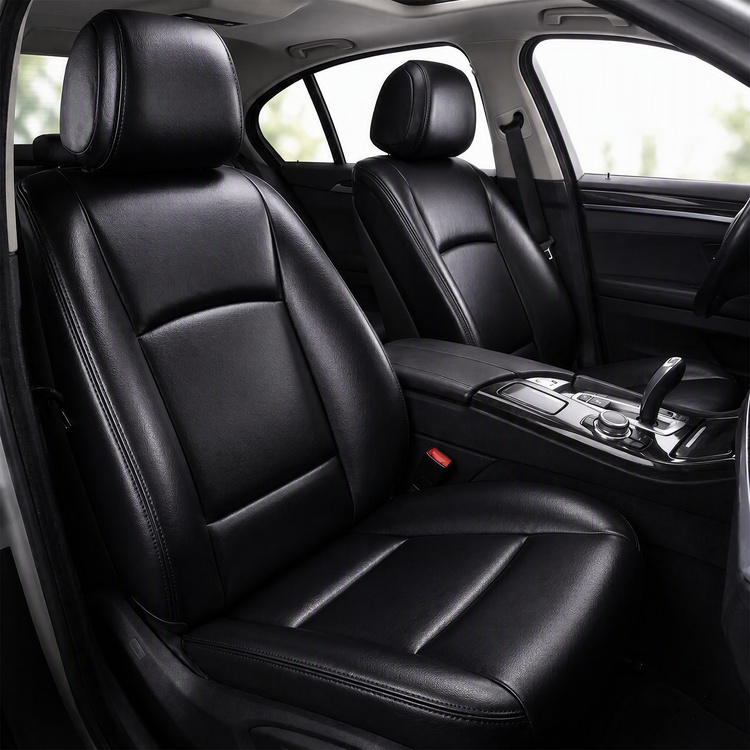
Nappa generally describes soft, supple natural leather rather than a single standardized performance grade. The term alone does not establish friction, coating thickness, durability, or suitability for steering wheels.
A soft Nappa steering wheel cover may feel luxurious, but softness is not proof of reliable grip. Its finish, surface condition, and construction still need evaluation.
Buyers should also distinguish genuine Nappa leather from Nappa-style synthetic leather. A synthetic material can reproduce a fine grain and soft touch without being animal leather.
Microfiber leather typically combines an ultrafine-fiber nonwoven structure with polyurethane. Depending on its construction and finishing process, it can have a grain-coated surface or a suede-like appearance.
This distinction matters because drivers touch the finished surface, not just the underlying microfiber structure. Two microfiber products can therefore feel very different.
Nappa and microfiber are not always opposing categories: a microfiber leather can be engineered with a Nappa-style grain and hand feel. Request a clear composition statement before comparing quotations.
The practical answer is to choose the tested surface, not the more impressive label.
For a luxury-oriented cover, genuine Nappa may be a strong candidate when a supple natural-leather feel is central to the product. For a customized synthetic cover, microfiber provides a useful platform for specifying grain, softness, and finish.
However, neither position proves superior wet-hand or long-term grip.
| Selection factor | Soft genuine Nappa leather | Microfiber leather |
|---|---|---|
| Material identity | Animal-derived leather | Engineered synthetic leather |
| Hand feel | Depends on hide, processing, and finish | Depends on fiber structure, coating, and finish |
| Dry-hand grip | Must be assessed on the finished sample | Must be assessed on the finished sample |
| Damp-hand grip | Cannot be inferred from softness | Cannot be inferred from microfiber content |
| Appearance | Natural character varies by specification | Grain and appearance can be specified |
| Purchasing priority | Verify finish and automotive suitability | Verify construction and automotive suitability |
Surface finish is a critical selection variable. A comfortable material still needs to demonstrate that it remains controllable during repeated hand movement, moisture exposure, and cleaning.
*[Suggested image: Side-by-side close-ups of genuine Nappa and Nappa-style microfiber samples, labeled with verified material composition.]*
A steering wheel cover needs a balance between secure contact and comfortable hand repositioning. An excessively slick surface is undesirable, but a sticky surface is not automatically better.
Compare samples for surface drag, tackiness, and consistency. Do not assume that a deeper grain or more matte appearance guarantees improved grip.
The topcoat deserves particular attention because it is the layer exposed to hands, cleaning products, and daily contact.
A clean, dry sample tells only part of the story. Buyers should also consider slightly damp hands and the effects of sweat, skin oils, and permitted personal-care products.
These conditions should be evaluated rather than reduced to broad claims such as "sweatproof" or "non-slip."
A useful question is: does the surface remain predictable, or does it become noticeably slippery, sticky, or uneven?
Material-to-hand contact and cover-to-wheel attachment are separate issues.
Even a promising surface cannot compensate for a cover that rotates, bunches, or fits poorly. Evaluate the completed cover, including seams, backing, thickness, and attachment method.
For installation and compatibility, follow the vehicle manufacturer's guidance. Material selection alone does not establish that an accessory is safe for every steering wheel.
Soft Nappa deserves consideration when natural-leather identity and a supple feel are important purchasing criteria. Confirm that the selected grade and finish are intended for the application.
Do not substitute an attractive upholstery sample for a steering-wheel-specific evaluation.
Microfiber leather is worth evaluating when the project requires a defined synthetic construction and a coordinated texture, color, and hand feel.
At Tianhai Leather, our role is to help translate those requirements into a material development brief and small-batch customization discussion. Any proposed grade should then be assessed against the buyer's actual application requirements.
There is no defensible category-wide winner without comparable testing.
Specify damp-contact conditions and compare finished samples using the same procedure. A claim about breathability or water resistance is not equivalent to evidence of steering wheel grip.
A repeatable screening process is more useful than deciding from a photograph or a brief showroom touch.
The following is a proposed purchasing workflow, not a standardized safety certification.
Record each sample's composition, thickness, backing, finish, and intended application. Where possible, compare samples with similar thickness and cover construction.
Otherwise, differences in padding or fit may be mistaken for differences in material grip.
Use clean hands and consistent sample preparation. Assess initial grip, comfort, surface drag, and ease of repositioning.
Record observations separately. "Soft," "grippy," and "comfortable" should not be treated as interchangeable descriptions.
Use a documented, repeatable moisture condition. Compare whether each surface changes noticeably from its dry state.
For quantitative friction measurements, ask a qualified laboratory to define the contact material, load, speed, conditioning, and reporting method. Results are only meaningfully comparable when the methods align.
Evaluate samples after agreed exposure to relevant contaminants and approved cleaning products.
Check for changes in gloss, tackiness, color transfer, cracking, or coating separation. A strong first impression should not replace assessment after conditioning.
Fit the prototype to a suitable stationary evaluation wheel. Inspect attachment, seam placement, thickness, bunching, and movement between cover and wheel.
Do not conduct improvised public-road slip tests.
A report is useful only when its scope matches the claim.
For example, ISO 11640 describes leather color-fastness testing under repeated rubbing. It can help evaluate surface behavior and color transfer, but it does not directly prove steering wheel grip.
Similarly, an abrasion result should not be presented as a coefficient-of-friction result.
Ask suppliers to identify:
- The exact material code and tested construction.
- The test method and conditioning procedure.
- The measured result and acceptance criteria.
- Whether testing covered the original or aged surface.
- The laboratory, report date, and sample identification.
Comparable testing matters more than an isolated high number. Avoid comparing results produced under different methods as though they were interchangeable.
No universal abrasion-cycle figure should be presented as an automotive approval threshold without identifying the relevant specification.
Cleaning is part of material performance, not a separate afterthought.
Request care instructions for the exact finish. Do not assume that a cleaner, conditioner, or dressing suitable for another leather product is appropriate for a steering wheel cover.
During development, repeat the cleaning procedure and check whether the surface becomes slick, sticky, discolored, or uneven.
At Tianhai Leather, environmentally focused synthetic leather development is part of our stated business direction. However, environmental language should remain specific and supported.
"Microfiber," "vegan," "water-based," and "eco-friendly" describe different things. None independently proves lower environmental impact across a product's entire life cycle.
Ask for evidence relevant to the claim, such as verified material composition, recycled-content documentation, restricted-substance results, or applicable emissions testing.
Also verify animal-free claims across the complete construction, including adhesives and other components, rather than relying on the surface material alone.
Our business combines synthetic leather development, production, and customization for multiple applications. For steering wheel cover projects, we recommend beginning with an application brief rather than a generic request for "premium leather."
A useful brief includes:
1. Target vehicle or steering wheel dimensions.
2. Cover construction and attachment method.
3. Desired grain, color, gloss, and hand feel.
4. Thickness and backing requirements.
5. Expected climate and cleaning conditions.
6. Required tests and acceptance criteria.
7. Sample quantity and anticipated order volume.
This approach helps connect appearance requirements with manufacturing and evaluation needs.
It also prevents a common purchasing mistake: approving a beautiful swatch before confirming that the completed cover meets the project's functional requirements.
No. Microfiber describes a material construction, not a guaranteed friction level. Compare the actual finished surfaces under equivalent dry, damp, and conditioned states.
Nappa traditionally refers to soft natural leather, but commercial descriptions also include "Nappa-style" synthetics. Ask suppliers to state clearly whether the material is genuine leather or synthetic.
Yes. Microfiber leather can be finished to provide a soft hand feel and fine-grain appearance. That does not make it genuine Nappa leather, and it does not automatically establish grip performance.
Neither category wins without testing. Evaluate damp-hand contact and any changes after relevant contamination and cleaning. Avoid relying on softness, breathability, or marketing descriptions alone.
No. Abrasion resistance concerns wear under a specified procedure. Grip requires a separate assessment of friction or controlled hand-contact behavior.
Request composition details, representative samples, care instructions, applicable test reports, and a prototype of the completed cover. Ensure the approved production specification matches the evaluated sample.
The best steering wheel cover material is not simply the softest or the most expensive. It is the one that combines comfortable contact, secure construction, and evidence appropriate to its intended use.
Contact Tianhai Leather with your target texture, color, thickness, cover design, test requirements, and expected quantity. Start with a small-batch sample discussion, evaluate the finished prototype, and approve production against a clearly defined specification.
The sources below support material definitions, construction descriptions, and the stated scope of rubbing tests. They do not establish a universal grip ranking or certify Tianhai Leather products.
1. Company introduction supplied by Tianhai Leather (Dongguan) Co., Ltd.
Source for the company's stated business scope, application areas, and small-batch customization positioning. No company website, customer reviews, or product test reports were supplied.
2. ISO — *ISO 11640:2018: Leather—Tests for colour fastness—Colour fastness to cycles of to-and-fro rubbing.*
Supports the distinction between rubbing/color-fastness evaluation and a direct grip claim. [iso]
3. Kuraray, CLARINO Division — *Material.*
Explains microfiber nonwoven structures, polyurethane impregnation, and the distinction between suede-type and grain-coated finishes. Brand-specific descriptions should not be generalized to every microfiber product. [clarino.kuraray]
4. Kuraray, CLARINO Division — *How CLARINO Differs from General Synthetic Leather.*
Describes a microfiber nonwoven base and polyurethane construction as a manufacturer example, not as evidence of Tianhai product performance. [clarino.kuraray]
5. Kuraray Europe — *amaretta: Finest Leather Alternative.*
Provides a manufacturer example of polyamide/polyurethane-based microfiber nonwoven construction. [kuraray]
6. Wikipedia — *Napa Leather.*
Provides background on Nappa as a generic soft-leather term without a distinct characterization test. Used for terminology, not product-performance claims. [en.wikipedia]
Hot Tags: China, Global, OEM, private label, manufacturers, factory, suppliers, manufacturing company
