


Phone:
+86 138 0927 7026


Views: 278 Author: Tianhai Leather Publish Time: 2026-10-12 Origin: Site


Content Menu
● Top PU Leather Manufacturers and Suppliers in Vietnam: The Shortlist
>> 1. Tianhai Leather: A Custom Synthetic Leather Partner
>> 2. San Fang: A Synthetic Leather Manufacturer With Vietnam Operations
>> 3. Nan Ya Plastics: PU Leather Production in Vietnam
>> 4. Luc Quan Plastic: PU, Semi-PU, and PVC Options
>> 5. Yucheng Materials: PU, TPU, and Microfiber Development
● How to Compare PU Leather Beyond Appearance
>> Build an Application-Specific Requirement Sheet
>> Ask What Happens After Aging
● A Practical Workflow for Small-Batch Custom PU Leather
>> Step 1: Send a Complete Design Brief
>> Step 2: Separate Appearance Approval From Technical Approval
>> Step 3: Run a Production Trial
>> Step 4: Lock the Specification
● An Illustrative Sourcing Scenario: Custom Marine Seating
● How to Assess Environmental Claims Without Greenwashing
● Vietnam Manufacturing or Cross-Border Custom Supply?
● Request a Project-Specific Proposal From Tianhai Leather
>> Is Tianhai Leather a Vietnam-Based PU Leather Manufacturer?
>> Which Listed Companies Publish Manufacturing Operations in Vietnam?
>> Can I Order Small Quantities of Custom PU Leather?
>> What Should I Include in a PU Leather RFQ?
>> Does "Eco-Friendly" Mean the Material Is Biodegradable?
>> How Can I Verify a Supplier's Test Report?
Finding the right partner among the Top PU leather Manufacturers and Suppliers in Vietnam requires more than comparing colors and prices. Buyers need to understand material specifications, manufacturing locations, customization options, and the evidence behind performance claims.
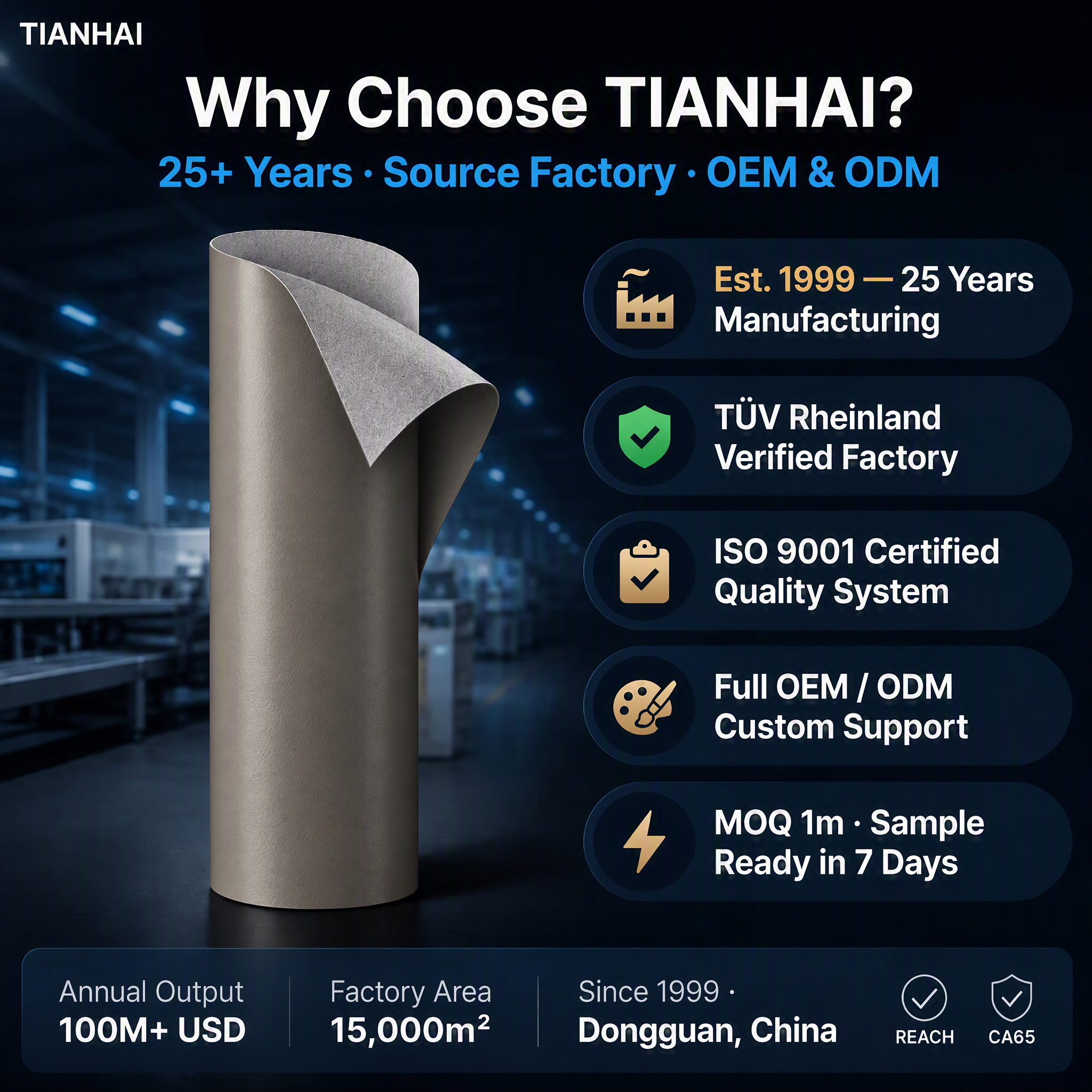
At Tianhai Leather (Dongguan) Co., Ltd., our focus is synthetic leather research, manufacturing, and customization for automotive interiors, yacht upholstery, furniture, footwear, and bags. In this guide, we introduce our business first, alongside manufacturers with publicly documented operations in Vietnam.
One distinction matters immediately: Tianhai is based in Dongguan, China, not Vietnam. This is a company-published sourcing shortlist, not an independent market-share ranking. Its purpose is to help buyers compare local manufacturing options with a China-based customization partner.
A useful supplier comparison separates verified manufacturing presence from application suitability. A factory producing footwear materials is not automatically the right choice for marine seating or automotive trim.
| Manufacturer | Published manufacturing location | Relevant capabilities | What buyers should verify |
|---|---|---|---|
| Tianhai Leather (Dongguan) Co., Ltd. | Dongguan, China | Synthetic leather development and small-batch customization, according to company-provided information | Material construction, application testing, MOQ, and delivery arrangements |
| San Fang Chemical Industry | Manufacturing network includes Vietnam | Synthetic leather and film; Vietnam-based R&D presence | Product fit, factory allocation, technical support, and order requirements |
| Nan Ya Plastics | Vietnam synthetic leather plant | PU synthetic leather; published footwear manufacturing experience | Grade availability, production scheduling, and application-specific documentation |
| Luc Quan Plastic | Vietnam | PU, semi-PU, and PVC synthetic leather | Exact composition, backing, thickness, and product-specific performance |
| Yucheng Materials | Manufacturing network includes China and Vietnam | PU, TPU, and microfiber products | Which processes occur at the quoted factory and which product grades are available |
The Vietnam manufacturing information above comes from the companies' published websites or product literature. These descriptions establish a sourcing starting point, not independent verification of every product claim.
We develop and manufacture synthetic leather for customers seeking coordinated material supply and customization.
Our stated application areas include:
- Automotive interiors.
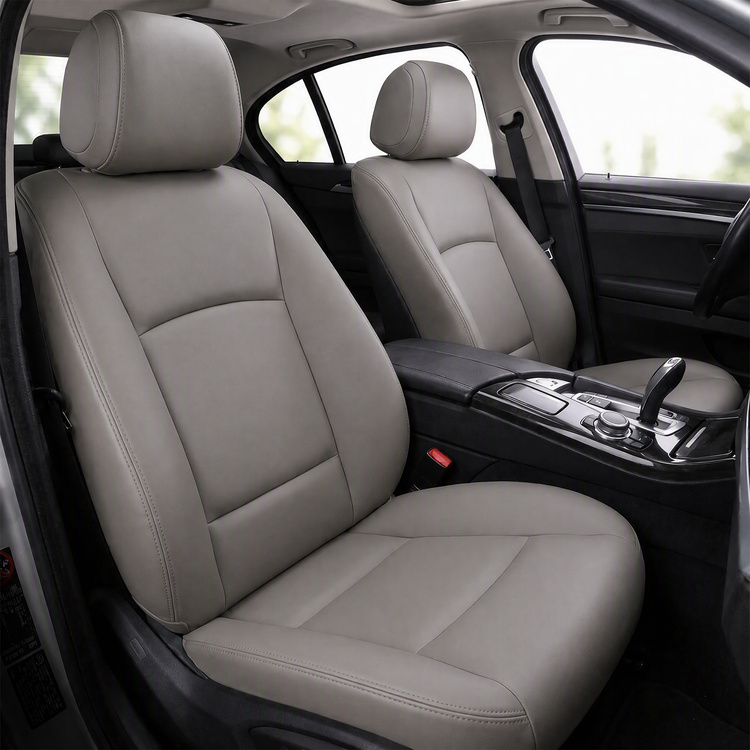
- Yacht and marine upholstery.
- Residential and commercial furniture.
- Footwear components.
- Bags, luggage, and accessories.
For buyers considering small-batch custom PU leather, the first conversation should define the application rather than begin with a generic catalog selection.
A furniture brand may prioritize hand feel, grain, and cleanability. A footwear manufacturer may need to evaluate flexing and bonding. A marine upholstery project should establish its exposure conditions before selecting a material.
Our company profile emphasizes advanced production processes, quality management, industry experience, and environmentally oriented development. However, buyers should request grade-specific evidence before making durability or environmental claims about a finished product.
Tianhai is worth considering when customization is central to the project. Confirm minimum quantities, sample development costs, testing responsibilities, and shipment arrangements directly with us.
San Fang publishes a manufacturing network spanning Taiwan, China, Vietnam, and Indonesia. Its website also identifies offices and an R&D center in Vietnam, alongside synthetic leather and film products.
This makes San Fang a relevant company to investigate when buyers want a supplier with both manufacturing and development resources in Vietnam.
The practical question is not simply whether the company manufactures synthetic leather. Ask which product family matches your application, where that material will be produced, and how sampling connects to bulk production.
Buyers should also confirm order quantities and development support rather than assume that a large manufacturing network accepts small custom orders.
Nan Ya's official Vietnam plant literature identifies PU synthetic leather manufacturing and experience supplying shoe factories. Its broader synthetic leather website lists a Vietnam plant and describes applications including footwear, furniture, automotive materials, and sports equipment.
Nan Ya is therefore a relevant candidate for buyers evaluating established PU leather production in Vietnam.
The Vietnam plant brochure reports monthly capacity of approximately four million yards. Treat this as a published company figure, not a guarantee of current available capacity or lead time. Ask for an updated production quotation.
Also distinguish group-level product capabilities from the exact grades available at the Vietnam plant.
Luc Quan describes itself as a Vietnam-based synthetic leather manufacturer and trader established in 2013. Its published range includes PU, semi-PU, and PVC materials, with applications such as footwear, garments, and seat covers.
Its mixed-material portfolio makes composition clarification especially important.
Request the coating structure, backing specification, thickness tolerance, and relevant performance reports. Do not treat PU, semi-PU, and PVC as interchangeable simply because their finished surfaces look similar.
Buyers comparing quotations should ensure that suppliers are pricing equivalent constructions.
Yucheng publishes production bases in China and Vietnam. Its website identifies dry-process and finishing operations in its southern Vietnam base, plus a development center and warehouse in Hai Phong. Its product portfolio includes PU, TPU, and microfiber materials.
This is relevant for buyers exploring different material families or regional development support.
Before ordering, confirm where coating, finishing, inspection, and shipment will take place. A company's Vietnam presence does not mean every material in its catalog is entirely manufactured there.
My recommendation to purchasing teams is straightforward: compare specifications before comparing unit prices.
A sample can look attractive while leaving essential questions unanswered. Your evaluation should establish what the material is, how it performs, and whether the production version will match the approved sample.
Use the following as a purchasing checklist, not a universal performance standard.
| Application | Questions to include in the specification |
|---|---|
| Automotive interiors | What customer requirements apply to abrasion, emissions, odor, light exposure, and flammability? |
| Marine upholstery | What moisture, sunlight, cleaning, and storage conditions must the material tolerate? |
| Furniture | What are the requirements for abrasion, seam performance, stain removal, and hand feel? |
| Footwear | What flexing, adhesion, abrasion, and manufacturing-process requirements apply? |
| Bags and luggage | What tear, rubbing, folding, and edge-processing requirements apply? |
Define acceptance criteria with your customer, technical team, or testing laboratory. Avoid selecting test thresholds simply because a supplier uses them in promotional literature.
Initial appearance is only part of material evaluation.
Ask suppliers whether relevant properties have been evaluated after controlled aging, and request the conditions and acceptance criteria. ISO 1419:2019 describes accelerated-aging methods for rubber- or plastics-coated fabrics. Such testing provides a structured evaluation framework; it should not be presented as an automatic prediction of service life.
A useful report identifies:
- The tested material and batch.
- The method and edition used.
- Temperature, humidity, and exposure duration.
- Properties assessed before and after exposure.
- Pass criteria and observed changes.
Small-batch customization is easier to manage when both parties agree on the development sequence.
Provide the end use, target market, reference sample, color target, grain preference, thickness, backing, and approximate order volume.
Include the expected manufacturing process. The supplier needs to know whether the material will be sewn, laminated, bonded, folded, or otherwise processed.
Approve color, grain, gloss, and hand feel separately from performance.
A visually approved sample should not automatically authorize production if testing remains incomplete.
Record the sample code and revision so that later changes do not create confusion.
Evaluate the material on your own equipment before committing to a larger order.
The trial should use the intended assembly process and assess the finished component, not only the material roll.
For a small order, agree in advance on trial quantities, evaluation costs, and the response if the material needs adjustment.
The purchase order should identify the approved construction, tolerances, packaging, inspection criteria, and treatment of nonconforming material.
Specify whether substitutions require written approval. This helps prevent a technically different material from being supplied under the same general product name.
Consider a yacht upholstery buyer seeking a distinctive grain and a limited initial quantity. This is an illustrative workflow, not a documented Tianhai customer case.
The buyer first records exposure conditions, cleaning practices, storage expectations, and assembly requirements. The supplier then proposes a construction and supplies appearance samples.
After visual approval, the buyer requests relevant technical evidence and tests the material in a seat assembly. Only after that evaluation does the buyer approve the production specification.
The lesson is useful across applications: an attractive swatch is a development milestone, not the complete qualification process.
Suggested visual: insert a labeled image sequence showing the reference sample, approved swatch, trial seat, and final inspection.
"Eco-friendly PU leather" is a search phrase, but it is not a complete purchasing specification.
Ask what the claim actually covers: a particular chemical restriction, recycled content, processing method, or another measurable characteristic. The FTC's Green Guides caution against broad, unqualified environmental claims and recommend specific, substantiated explanations.
For European-market projects, identify the applicable REACH restrictions and documentation requirements. ECHA explains that restrictions can apply to substances on their own, in mixtures, or in articles. A general compliance statement should not replace evaluation of the specific material and intended use.
Request evidence linked to the quoted product. Do not assume that one certificate applies to every color, finish, backing, or manufacturing site.
There is no universal winner between local manufacturing and a cross-border supplier.
Compare both options using the same specification and delivery assumptions.
Assess:
1. Material suitability and technical evidence.
2. Minimum quantities and customization flexibility.
3. Sample and production schedules.
4. Freight, duties, handling, and payment terms.
5. Inspection, complaint handling, and replacement arrangements.
If Vietnamese origin is commercially important, verify it separately. A local office, warehouse, or shipment point does not by itself establish the manufacturing origin of the material.
Send Tianhai Leather your application, reference sample, required quantity, target thickness, color, grain, and testing requirements.
Ask us to outline available constructions, customization options, sampling steps, minimum quantities, and delivery terms.
If your project requires Vietnamese manufacturing origin, state that requirement at the beginning. If your priority is customized synthetic leather with a small initial order, request a development discussion before committing to bulk purchasing.
No. Tianhai Leather (Dongguan) Co., Ltd. is based in Dongguan, China. It appears first because this is Tianhai's company-published sourcing guide, not a ranking of exclusively Vietnamese factories.
San Fang, Nan Ya, Luc Quan, and Yucheng publish Vietnam manufacturing operations or facilities. Confirm the production location of the exact material you intend to buy.
Tianhai's supplied company profile includes small-batch customization. The actual minimum quantity depends on the proposed material and development requirements. Obtain written confirmation rather than assuming a fixed MOQ.
Include application, construction requirements, thickness, backing, color, grain, quantity, required tests, destination, and delivery expectations. Attach an approved reference sample where possible.
Not necessarily. Environmental claims describe different characteristics. Biodegradability requires its own substantiation and qualifications; it should not be inferred from a general "eco-friendly" description. [ftc]
Check the material identifier, report date, laboratory, method, test conditions, and acceptance criteria. Confirm that the report relates to the construction being quoted, and arrange additional testing when your customer requires it.
Hot Tags: China, Global, OEM, private label, manufacturers, factory, suppliers, manufacturing company
