


Phone:
+86 138 0927 7026


Views: 236 Author: Tianhai Leather Publish Time: 2026-10-13 Origin: Site


Content Menu
● What Makes the Best Leather for Car Seats?
● Genuine Leather vs. Synthetic Leather for Car Seats
● Why Synthetic Leather Is Increasingly the Smart Choice
● The Tests That Separate Good Car-Seat Leather From Poor Leather
● How Climate Changes the Best Leather Choice
>> Humid and Marine Environments
● Matching Leather to Vehicle Type
● The Case for Small-Batch Custom Leather
● How to Evaluate a Leather Supplier
● Common Mistakes When Choosing Car-Seat Leather
>> 1. What is the best leather for car seats?
>> 2. Is synthetic leather durable enough for car seats?
>> 3. Does leather car-seat material get too hot in summer?
>> 4. What is better: PU leather or genuine leather for car seats?
>> 5. How can I tell if car-seat leather is high quality?
>> 6. Can synthetic leather be customized for small orders?
The best leather for car seats is not simply the most expensive leather. For most modern vehicles, the right choice depends on how the seat will be used, the climate it must survive, the desired interior aesthetic, and whether the project requires OEM-level durability or small-batch customization. As a manufacturer specializing in synthetic leather for automotive interiors, Tianhai Leather (Dongguan) Co., Ltd. sees the same decision repeatedly: buyers want a material that looks premium, resists daily abuse, meets environmental expectations, and remains practical to produce at scale.
This guide explains how to choose the best car-seat leather from an industry-insider perspective. It compares genuine leather, PU leather, microfiber leather, and silicone-based alternatives; explains the tests that matter; and shows how custom synthetic leather can deliver a high-end driving experience without the cost and supply variability of natural hides.
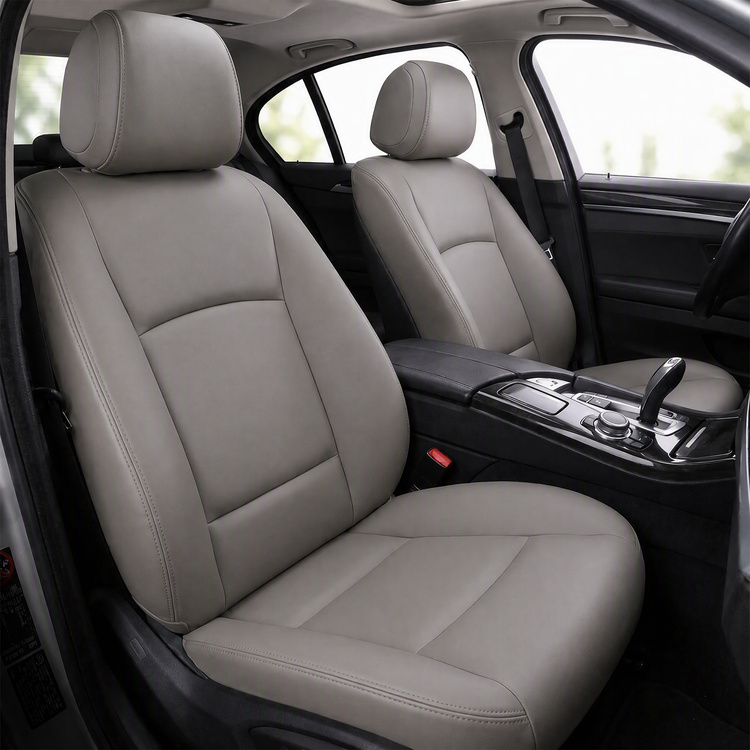
Car-seat upholstery is one of the most demanding applications in interior materials. A seat surface must tolerate body pressure, friction from clothing, sunlight, temperature swings, moisture, cleaning chemicals, and repeated flexing every time a passenger enters or exits the vehicle.
The best leather for car seats should offer:
- High abrasion resistance to withstand everyday entry, exit, and movement.
- Excellent flex endurance so the surface does not crack at seams, bolsters, or seat edges.
- Strong colorfastness to prevent fading from sunlight and transfer from clothing.
- Low VOC emissions for better cabin air quality.
- Heat and cold stability for vehicles used in hot, humid, or freezing climates.
- Easy cleaning and stain resistance for families, rideshare fleets, commercial vehicles, and marine applications.
- Consistent color, texture, and thickness so production batches match across an entire vehicle interior.
In our production experience, buyers often focus first on appearance. That is understandable—seat leather defines the perceived quality of a cabin. But appearance alone does not make a material suitable for automotive seating. A beautiful surface that cracks after two summers, peels at the side bolsters, or releases strong odor will cost far more in warranty claims and customer dissatisfaction than it saves upfront.
There is no single "best" material for every vehicle. Genuine leather remains popular in luxury vehicles, while advanced synthetic leathers now dominate many mainstream, electric-vehicle, marine, and custom-interior projects because they offer consistency, design flexibility, and easier scalability.
| Material | Best For | Key Advantages | Main Limitations |
|---|---|---|---|
| Full-grain genuine leather | Premium luxury vehicles, collector cars | Natural grain, prestige, develops patina | Higher cost, natural variation, more maintenance |
| Top-grain genuine leather | Mainstream luxury seating | Softer, more uniform than full-grain | Still costly; requires careful care |
| PU synthetic leather | Family cars, EVs, fleets, custom interiors | Consistent appearance, easier cleaning, broad color range | Quality varies greatly by formulation |
| Microfiber synthetic leather | High-wear seats, performance interiors | Excellent durability, fine texture, strong abrasion resistance | Usually higher cost than standard PU |
| Silicone leather | Hot climates, marine, child seats, easy-clean interiors | Strong heat/UV resistance, low odor potential, easy maintenance | Fewer traditional leather-like grain options |
| PVC leather | Budget applications | Low cost, water resistance | Can feel less premium and may have higher environmental concerns |
For buyers asking, "What is the best leather for car seats?", our practical recommendation is straightforward:
- Choose premium genuine leather when brand heritage, natural texture, and luxury positioning are the priority.
- Choose high-performance PU or microfiber synthetic leather when consistency, customization, stain resistance, and controlled cost matter most.
- Choose silicone or advanced low-VOC synthetic leather for demanding heat, marine, family, or sustainability-focused applications.
Synthetic leather has evolved far beyond the stiff, shiny material many people remember from older vehicles. Modern automotive-grade PU leather and microfiber leather can replicate the softness, grain, matte finish, and stitching appearance of natural leather while offering more predictable performance.
At Tianhai Leather (Dongguan) Co., Ltd., we develop synthetic leather for automotive interiors, yachts, furniture, footwear, luggage, and other applications. Our focus is on environmentally conscious formulations, advanced production processes, strict quality management, and flexible small-batch customization.
From a manufacturing perspective, synthetic leather offers several advantages that are difficult for natural hides to match:
- Batch consistency: Color, embossing, thickness, and surface finish can be controlled across large production runs.
- Design freedom: Customers can specify grain pattern, gloss level, softness, backing, color, perforation, and functional coating.
- Faster development: New colors, textures, and performance requirements can be sampled without waiting for hide availability.
- Better suitability for customization: Small-batch orders are practical for aftermarket seat covers, marine seating, prototype vehicles, and specialty interiors.
- Easier cleaning: Many synthetic surfaces resist coffee, sunscreen, food stains, and everyday dirt better than untreated natural leather.
- Animal-free construction: Synthetic leather provides a leather-like solution without using animal hides.
This is especially relevant for electric vehicles. EV interiors often emphasize minimalist design, sustainable materials, quiet cabins, and low odor. Water-based polyurethane systems and solvent-free TPU-based synthetic leather approaches can help reduce volatile organic content in the vehicle cabin, an increasingly important requirement for both OEMs and consumers.
A leather sample may feel soft in a showroom, but that tells you very little about how it will perform after years of use. Professional automotive buyers evaluate materials through standardized physical and chemical testing.
Important test categories include:
- Abrasion resistance: Measures surface wear caused by rubbing. Martindale and Taber methods are commonly used in upholstery and automotive specifications.
- Tensile strength and elongation: Evaluates how the material handles stretching and stress. ISO 3376 is a widely referenced method.
- Tear strength: Determines resistance to tearing at stress points, seams, and perforations.
- Flexing endurance: Simulates repeated bending, which is critical around seat bolsters, side panels, and stitched areas. ISO 5402-1 is a primary reference.
- Colorfastness: Checks resistance to rubbing, light exposure, and color transfer. Relevant standards include ISO 11640 and ISO 105-B02.
- Water resistance and absorption: Important for spilled drinks, humidity, cleaning, and marine environments.
- Chemical safety: Tests may include chromium VI, formaldehyde, and azo dyes, depending on the market and customer specification.
For car seats specifically, abrasion performance is one of the clearest predictors of long-term appearance. Poor abrasion resistance can lead to surface loss, color transfer, gloss change, and premature aging. Automotive test protocols such as VDA 230-211 and EN ISO 17076-2 were developed to better correlate laboratory abrasion testing with real-life seat conditions.
Before approving a car-seat leather material, request:
1. A technical data sheet with thickness, weight, and base-material information.
2. Abrasion, flex, tear, and tensile test reports.
3. Colorfastness results for rubbing and light exposure.
4. VOC or odor test data where applicable.
5. Cold-crack and heat-aging results for your target climate.
6. Flame-retardancy documentation if required by the vehicle market.
7. Physical samples in the actual color, embossing, and thickness you intend to use.
8. A pilot production sample before full-scale manufacturing.
Many buyers select seat material without considering where the vehicle will actually be used. That is a costly mistake.
In regions with intense sunlight and high cabin temperatures, UV stability and heat aging become critical. Dark genuine leather can become hot to the touch and may fade or dry out over time. High-quality synthetic leather with UV-resistant pigments, stable coatings, and heat-aged formulations can maintain color and surface integrity more predictably.
For convertibles, vehicles with large glass roofs, and cars regularly parked outdoors, we recommend prioritizing:
- High lightfastness ratings.
- Heat-aging resistance.
- Anti-yellowing performance.
- Low-gloss or matte finishes to reduce visual heat buildup.
In cold regions, materials must resist cracking when temperatures drop. Flexible PU formulations, suitable backing fabrics, and controlled plasticizer systems help maintain softness in winter. Cold-crack testing is especially important for aftermarket seat covers and vehicles stored outdoors.
Boats, yachts, and coastal vehicles expose seating materials to moisture, salt air, sunscreen, and frequent cleaning. In these environments, hydrolysis resistance, anti-mildew performance, and easy-clean coatings matter as much as appearance.
Tianhai Leather supplies materials for both automotive and marine interiors, where the same core principle applies: the leather must perform in its real environment, not only in a catalog photo.
The best leather for car seats also depends on the vehicle category.
| Vehicle Type | Recommended Material Direction | Why |
|---|---|---|
| Luxury sedan | Fine-grain genuine leather or premium microfiber synthetic leather | Premium touch, refined appearance, strong durability |
| Family SUV | High-abrasion PU or microfiber synthetic leather | Stain resistance, easy cleaning, consistent color |
| Electric vehicle | Low-VOC PU, TPU-based, or silicone synthetic leather | Supports modern sustainability and cabin-air expectations |
| Commercial fleet | Heavy-duty synthetic leather | Repeated use, easy maintenance, lower replacement cost |
| Rideshare vehicle | Stain-resistant PU or silicone leather | Frequent passenger turnover and cleaning |
| Sports car | Perforated microfiber or premium synthetic leather | Grip, breathability, sporty appearance |
| Classic car restoration | Custom synthetic leather or carefully selected automotive leather | Color matching, pattern replication, small-batch feasibility |
| Yacht or marine seating | Marine-grade synthetic leather | Moisture, UV, and cleaning resistance |
Large OEM programs usually require enormous quantities and long qualification cycles. But many customers do not need that scale. Restorers, aftermarket seat-cover brands, marine builders, furniture designers, and specialty vehicle manufacturers often need small-batch custom leather with precise color, texture, and performance requirements.
This is where a specialized synthetic leather manufacturer adds real value.
At Tianhai Leather, customization can include:
- Custom colors matched to a brand palette, vehicle interior, or existing trim.
- Grain embossing, from smooth Nappa-style surfaces to sporty perforated patterns.
- Thickness and softness adjustments for seat surfaces, bolsters, door panels, and steering wheels.
- Backing selection for sewing performance, shape retention, and comfort.
- Matte, semi-matte, or glossy surface finishes.
- Functional requirements such as abrasion resistance, flame retardancy, anti-static performance, or easy-clean coatings.
- Low minimum-order quantities for prototypes, limited editions, and specialty projects.
For example, a classic-car restoration shop may need a specific vintage beige with a subtle grain pattern. A marine upholstery brand may need white seating material that resists sunscreen stains and saltwater exposure. An EV startup may need a dark gray, low-gloss, low-odor interior material that supports a clean, sustainable brand image. In each case, the "best leather" is not a universal product—it is a material engineered for the application.
Choosing the best leather for car seats also means choosing the right supplier. A reliable manufacturer should be able to explain not only what the material is, but also why it performs the way it does.
Look for a supplier that provides:
- Transparent material specifications, including base fabric, coating system, thickness, and intended application.
- Test reports from recognized methods, such as Martindale or Taber abrasion testing, flex endurance, tear strength, and colorfastness.
- Sample approval before mass production, ideally using the actual sewing pattern and foam construction.
- Consistent quality control, including color matching, thickness inspection, surface inspection, and batch traceability.
- Customization capability, especially if your project requires unique colors, embossing, or small quantities.
- Clear communication about environmental requirements, including VOC, restricted substances, and applicable regional regulations.
A strong supplier should also ask questions about your end use. If a supplier immediately recommends a material without understanding whether the seats are for a family SUV, a luxury yacht, a rideshare fleet, or a high-temperature market, that is a warning sign.
Even experienced buyers make avoidable errors. These are the issues we see most often:
- Choosing by price alone. The cheapest material often fails first at seams, bolsters, and high-contact areas.
- Ignoring abrasion testing. A soft hand feel does not guarantee wear resistance.
- Overlooking flex durability. Seats bend constantly; cracking often begins where the material flexes most.
- Not testing the actual color. Color can look different under showroom lighting, daylight, and in-cabin lighting.
- Using furniture-grade material in vehicles. Automotive seating requires higher heat, abrasion, and flex performance than many furniture applications.
- Skipping climate-specific testing. A material suitable for a mild climate may fail in desert heat or northern winter conditions.
- Assuming all synthetic leather is the same. PU, PVC, microfiber, TPU, and silicone leather differ significantly in durability, odor, comfort, and environmental profile.
If you want the most dependable all-around answer to "What is the best leather for car seats?", choose a high-performance synthetic leather engineered for automotive use—particularly a premium PU or microfiber-based material with verified abrasion resistance, flex endurance, colorfastness, and low-VOC performance.
For buyers who value natural grain and traditional luxury, full-grain or top-grain automotive leather remains a strong choice. But for modern vehicle programs, custom interiors, fleets, EVs, and marine applications, advanced synthetic leather often delivers a better balance of appearance, durability, consistency, customization, and cost control.
Tianhai Leather (Dongguan) Co., Ltd. supports customers from material selection through sampling and production. Whether you need a standard automotive-grade synthetic leather or a fully customized color, texture, and performance specification, we can help you develop a solution suited to your vehicle, climate, budget, and brand positioning.
Contact Tianhai Leather today to request samples, discuss your seat-leather specification, or start a small-batch custom project.
For most modern vehicles, high-quality automotive-grade synthetic leather—especially premium PU or microfiber leather—is the best balance of durability, comfort, easy maintenance, and customization. For traditional luxury positioning, full-grain or top-grain genuine leather remains an excellent option.
Yes. High-quality synthetic leather designed for automotive use can offer strong abrasion resistance, flex endurance, stain resistance, and colorfastness. The key is to choose an automotive-grade material with verified test data, not a low-cost furniture-grade alternative.
It can, especially dark genuine leather or lower-quality synthetic materials exposed to direct sunlight. Choosing a material with good heat aging and UV resistance, along with lighter colors, perforation, or ventilation, can improve comfort in hot climates.
Genuine leather offers natural texture and prestige, while PU leather offers greater batch consistency, easier cleaning, broader design options, and often better value. For families, fleets, EVs, and custom projects, high-quality PU leather is frequently the more practical choice.
Ask for technical data and test reports covering abrasion resistance, tear strength, tensile strength, flex endurance, colorfastness, heat aging, and VOC or odor performance. Then test a physical sample in the actual color, thickness, and construction you plan to use.
Yes. Specialized manufacturers such as Tianhai Leather can support small-batch customization, including custom colors, embossing, thickness, softness, backing, surface finish, and functional coatings.
- ISO — Leather and furs standards, including automotive leather abrasion testing: [https://www.iso.org/ics/59.140.30.html]
- Eurofins — How to test leather quality: 10 common leather testing methods: [https://www.eurofins.com/en/consumer-product-testing/softlines-hardlines/news-articles/how-to-test-leather-quality-10-common-leather-testing-methods-for-brands-and-manufacturers/]
- Lubrizol — Synthetic leather and vegan leather for automobile interiors: [https://www.lubrizol.com/industries/transportation-machinery-and-equipment/automotive-materials/automotive-interiors/synthetic-leather]
- PPT Group — Abrasion testing of leather and automotive seat applications: [https://customercare.pptgroup.com/hubfs/Martindale%20909%20BallPlateKit_A_EN.pdf]
- Fact.MR — PU dispersions for automotive leather market and low-VOC trends: [https://www.factmr.com/report/pu-dispersions-for-automotive-leather-market]
- Rolford Leather — Choosing the best leather for car upholstery and seats: [https://www.rolfordleather.com/blogs/leather-buying-guide/choosing-the-best-leather-for-car-upholstery-and-seats]
- Infinita Lab — Leather material properties and industrial testing standards guide: [https://infinitalab.com/blog/leather-material-properties-industrial-testing-standards/]
Hot Tags: China, Global, OEM, private label, manufacturers, factory, suppliers, manufacturing company
