


Phone:
+86 138 0927 7026


Views: 233 Author: Tianhai Leather Publish Time: 2026-10-27 Origin: Site


Content Menu
● Matte PU Leather vs Smooth PU Leather: Understanding the Difference
● Quick Comparison: Which Finish Fits Your Automotive Project?
● Why Low-Gloss PU Leather Matters for Automotive Interior Design
>> Evaluate Dashboard Reflections in the Vehicle
>> Separate Appearance Approval from Functional Approval
● Is Smooth PU Leather Better for Seats and Door Panels?
>> Check Comfort as a Complete Construction
>> Test Cleaning Instead of Assuming It
● What Actually Determines Automotive PU Leather Durability?
>> Abrasion and Changes in Surface Appearance
>> Heat, Humidity, and Accelerated Aging
● A Practical Five-Step Method for Comparing PU Leather Samples
>> 1. Define the Component and Its Risks
>> 2. Compare Samples on Equal Terms
>> 3. Review Lighting and Touch
>> 4. Test Contamination and Repeated Cleaning
>> 5. Build a Representative Prototype
● Match the Material to Each Interior Zone
● How to Specify Custom Automotive PU Leather
>> Request Evidence Behind Environmental Claims
>> Is Matte PU Leather Better Than Smooth PU Leather for Cars?
>> Can Smooth PU Leather Have a Matte Finish?
>> Does Matte PU Leather Last Longer?
>> Which PU Leather Is Easier to Clean?
>> Can I Use Furniture PU Leather in an Automotive Interior?
>> What Should I Send When Requesting Custom Samples?
● Develop the Right Finish with Tianhai Leather
At Tianhai Leather (Dongguan) Co., Ltd., we focus on synthetic leather research, manufacturing, and customization for automotive interiors, yachts, furniture, footwear, and bags. For automotive projects, one question deserves a closer look: matte PU leather vs smooth PU leather—which is better for automotive interior design?
Our recommendation is to select the finish by component, not by appearance alone. Low-gloss materials deserve priority for reflection-sensitive areas, while smooth surfaces can support a clean, refined aesthetic elsewhere. However, these options are not opposites: matte describes gloss, while smooth describes texture. A well-designed automotive PU leather can be both.
This distinction helps designers move beyond sample-book impressions and specify materials around visibility, touch, maintenance, manufacturing, and verified performance.
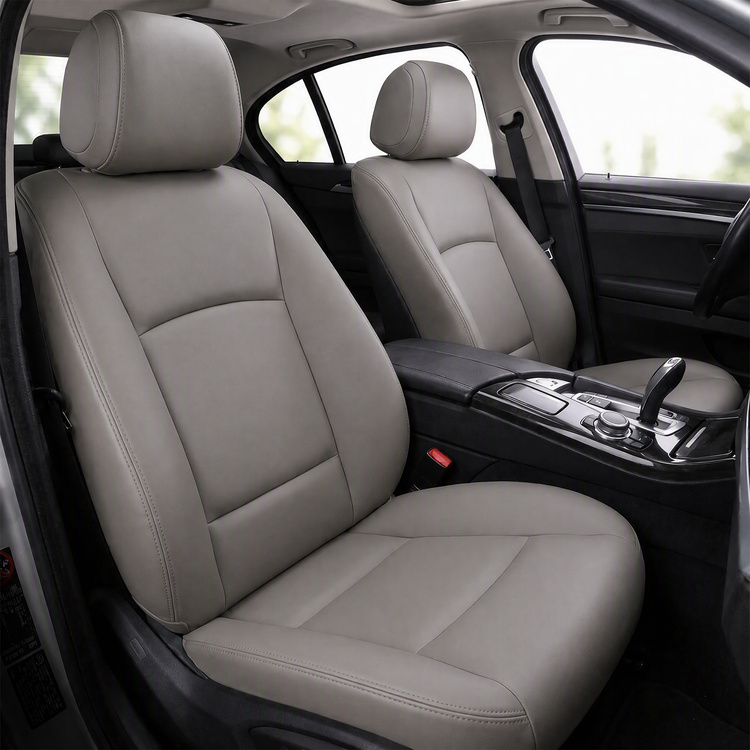
PU leather generally combines a polyurethane-based surface with a supporting substrate. Its finished character depends on the coating, backing, texture, color, and surface treatment—not one descriptive label.
Matte PU leather has a low-gloss appearance designed to limit pronounced surface highlights. It can have a fine grain, a pronounced embossed pattern, or a relatively smooth surface.
Designers may choose it for a restrained visual character. However, matte appearance does not automatically establish scratch resistance, low emissions, or long-term durability.
Smooth PU leather has relatively little surface texture. It may be matte, satin, or glossy, depending on its finishing system.
Consequently, "smooth" should not be treated as another word for "shiny." When requesting automotive upholstery samples, specify gloss and texture separately.
A useful starting brief is: "Fine-textured, low-gloss PU leather with a soft hand, intended for a door-panel insert." This communicates more than simply requesting matte leather.
| Selection factor | Matte PU leather | Smooth PU leather |
|---|---|---|
| Defining characteristic | Low surface gloss | Limited surface texture |
| Available appearance | Smooth or embossed | Matte, satin, or glossy |
| Reflection-sensitive applications | Worth prioritizing, followed by component validation | Suitable when its gloss and reflectance meet project requirements |
| Cleaning considerations | Depend on texture and coating | Limited texture may simplify wiping, but stain release still requires testing |
| Wear appearance | Check for polishing and changes in gloss | Check for visible scuffs and contact marks |
| Durability | Must be demonstrated through testing | Must be demonstrated through testing |
| Best purchasing approach | Specify gloss, construction, and performance | Specify texture, gloss, construction, and performance |
Neither category is automatically the premium option. The better material is the one that meets the requirements of its intended component.
*Suggested image: Place matched-color samples beneath this table, photographed under identical lighting. Include a smooth matte sample to demonstrate that texture and gloss are separate properties.*
The strongest reason to consider matte automotive interior materials is not fashion. It is the interaction between cabin surfaces, sunlight, and glazing.
Light reflected from an instrument panel can appear in the windshield and interfere with the view ahead. This effect, often called veiling glare, depends on several interacting factors, including dashboard reflectance, surface characteristics, windshield geometry, and lighting conditions.
A matte label alone cannot establish acceptable performance.
For an instrument-panel application, compare candidate materials in the intended geometry. Review them under different sunlight angles, rather than judging only a flat swatch under showroom lighting.
Color also matters. A light-colored low-gloss surface should not be assumed to behave like a darker one.
A material can look attractive on a desk and behave differently after wrapping a curved component.
Our recommended approach is to approve color and texture first, then verify the finished part's optical behavior. This prevents a visually appealing sample from becoming an unsuitable production choice.
Smooth PU leather can suit seating inserts, door-panel sections, and selected trim areas where the design calls for a clean, understated surface.
However, suitability depends on more than touch.
Seat comfort involves the cover material, foam, perforation, backing, seam design, and seat structure. Smoothness alone does not establish breathability, thermal comfort, or the right level of friction.
Evaluate a seating prototype rather than relying exclusively on a hand sample. Check how the surface behaves during entry, exit, and changes in seating position.
A surface with limited texture may offer fewer recesses for visible debris. Nevertheless, actual cleanability depends on the topcoat, contamination, cleaning product, and cleaning method.
Compare both finishes using the same controlled procedure. Potential challenges include denim transfer, skin oils, sunscreen, beverages, and approved interior cleaners.
Inspect the surface after cleaning for staining, tackiness, discoloration, or changes in gloss.
A common purchasing mistake is to treat matte and smooth as durability grades. They are appearance descriptors.
Automotive performance requires a broader assessment.
Ask how abrasion resistance was measured, not simply how many cycles a material survived.
ISO 5470-2 addresses wet and dry abrasion testing of coated surfaces. Results should identify the procedure, conditions, and endpoint.
Also inspect appearance. A surface may remain intact while developing polished areas, visible marks, or uneven gloss. These changes can matter to customers even before structural failure occurs.
Use accelerated-aging evaluations to investigate how the proposed material responds to relevant environmental stresses. ISO 1419 provides methods for assessing deterioration of coated fabrics.
Specify what will be assessed afterward: cracking, adhesion, flexibility, tackiness, or appearance, for example.
Avoid converting laboratory exposure directly into a promised number of service years without a validated correlation.
ISO 6452 addresses fogging characteristics of automotive interior trim materials. Fogging concerns constituents that can condense on cooler surfaces; it is not interchangeable with a complete cabin-emissions assessment.
Flammability is a separate requirement. For applicable materials evaluated under U.S. FMVSS 302, the specified maximum burn rate is 102 mm per minute under the prescribed conditions.
Neither matte appearance nor smooth texture proves compliance. Confirm the relevant market requirements, specimen construction, and supporting test documentation.
For designers and purchasing teams, a controlled comparison is more useful than a general claim that one finish is "better."
Identify whether the material will cover a seat bolster, door insert, armrest, or instrument-panel surface.
Record the expected contact, lighting exposure, cleaning practices, manufacturing process, and target market.
Where possible, hold color, thickness, backing, and construction constant while comparing finishes.
Otherwise, a perceived advantage may come from a different substrate or coating system rather than matte versus smooth appearance.
Inspect samples under daylight and cabin lighting. Evaluate them flat and wrapped around representative curves.
Record reflections, perceived color changes, tactile feel, and visible handling marks.
Agree on contaminants, exposure times, cleaning products, and evaluation criteria before testing.
Photograph samples before contamination, after cleaning, and after repeated cleaning cycles. Consistent documentation makes supplier comparisons more meaningful.
Check stitching, stretching, edge wrapping, and compatibility with the intended assembly.
Then confirm the necessary performance tests before final material approval. A successful swatch evaluation is an intermediate step, not production qualification.
*Suggested video: Show identical samples undergoing controlled wiping, flexing, and angled-light inspection. State the conditions and avoid presenting demonstrations as substitutes for laboratory tests.*
A single finish across the whole cabin may simplify visual coordination, but it should not replace component-specific evaluation.
| Interior zone | Main selection priority | Recommended evaluation |
|---|---|---|
| Instrument-panel upper surface | Reflection control | Review reflectance and appearance in representative windshield geometry |
| Seat bolster | Repeated contact and friction | Assess abrasion, flexing, and post-test appearance |
| Seat insert | Seating interaction and comfort | Evaluate the complete cover-and-seat construction |
| Door insert | Appearance and assembly | Check color consistency, wrapping, and cleaning |
| Armrest | Skin contact and frequent wiping | Test oils, approved cleaners, and gloss change |
| Decorative accent | Visual coordination | Assess lighting, marks, and consistency with adjacent materials |
This approach also supports mixed-finish designs. A low-gloss surface and a smooth matte insert can share a coordinated color while serving different functional requirements.
Tianhai Leather (Dongguan) Co., Ltd. offers synthetic leather development, production, and customization, including small-batch projects. Our role is to help translate a design concept into a clearly defined material request.
A useful inquiry should include:
- Component and intended application.
- Target market and relevant customer specifications.
- Color reference and acceptable variation.
- Texture or grain reference.
- Gloss expectation and agreed measurement conditions.
- Thickness, backing, and assembly requirements.
- Cleaning expectations and performance priorities.
- Sample quantity, anticipated volume, and development schedule.
For small-batch automotive customization, clarify whether the project concerns appearance exploration, prototype construction, or production supply. Each stage needs a different level of validation.
Environmental responsibility should be supported by specific information, not appearance or broad descriptions.
Neither "matte," "smooth," nor "PU" proves low emissions, recycled content, or a lower environmental footprint. Request documentation relevant to the exact formulation and claim.
Likewise, water-based processing should not be treated as automatic proof that every environmental or automotive requirement has been met.
Not universally. Matte describes gloss; smooth describes texture. Compare both properties alongside the requirements of the intended component.
Yes. A smooth surface can have a low-gloss finish. Specify texture and gloss separately when ordering samples.
Not inherently. Durability depends on the material construction, coating system, operating conditions, and verified test performance.
There is no universal winner. Limited texture may simplify wiping, but stain release and cleaner compatibility depend on the surface formulation.
Do not assume suitability. Assess it against the automotive project's safety, emissions, aging, manufacturing, and performance requirements.
Provide the application, color, texture, gloss expectation, construction requirements, performance specification, and estimated quantity. A reference sample or component drawing also helps.
The right automotive interior material is not simply matte or smooth. It is a defined combination of appearance, construction, and validated performance.
Contact Tianhai Leather (Dongguan) Co., Ltd. with your component drawings, reference samples, target finish, and project requirements. Request a small-batch sample comparison to evaluate color, texture, gloss, and assembly suitability before committing to the next development stage.
Hot Tags: China, Global, OEM, private label, manufacturers, factory, suppliers, manufacturing company
