


Phone:
+86 138 0927 7026


Views: 260 Author: Tianhai Leather Publish Time: 2026-11-03 Origin: Site


Content Menu
● Soft Nappa Leather vs Fine Grain Leather: Understand the Difference First
>> What Is Soft Nappa Leather?
>> What Is Fine Grain Leather?
● Quick Comparison: Which Finish Fits Your Premium Seating Project?
● What Actually Determines Premium Car Seat Upholstery Performance?
>> Softness Must Work With Seat Construction
>> Grain Size Does Not Establish Durability
>> Comfort Requires More Than a Soft Touch
● A Better Automotive Upholstery Test Checklist
>> Separate Fogging, VOCs, and Odor
>> Treat Accelerated Aging as Comparative Evidence
● A Five-Step Sample-to-Seat Validation Process
>> 2. Compare Equivalent Samples
>> 3. Build a Representative Seat Section
>> 4. Evaluate Before and After Exposure
>> 5. Approve a Reference Sample
● Small-Batch Customization: Reduce Risk Before Scaling
● Sustainability Claims: Ask for Specific Evidence
● Which Material Should You Choose?
>> Start Your Custom Upholstery Development With Tianhai Leather
>> Is soft Nappa leather always genuine leather?
>> Is fine grain leather the same as full-grain leather?
>> Which option is more durable for car seats?
>> Can synthetic upholstery work with ventilated seats?
>> Does low odor mean low VOC emissions?
>> How should premium synthetic car seats be cleaned?
>> What should I send Tianhai Leather for a quotation?
At Tianhai Leather (Dongguan) Co., Ltd., we help customers develop synthetic leather solutions for automotive interiors, yachts, furniture, footwear, and bags, including small-batch customization. When buyers ask, "Soft Nappa leather vs fine grain leather: which is better for premium car seat upholstery?" our recommendation starts with one principle: choose the material specification, not just the surface name.
Soft Nappa-style upholstery suits projects prioritizing a supple touch and understated luxury. Fine-grain upholstery suits projects seeking a subtle, consistent surface texture. Neither description alone proves better durability, comfort, or value.
For premium seating, the strongest choice combines your preferred appearance with verified performance, production consistency, and suitability for the complete seat.
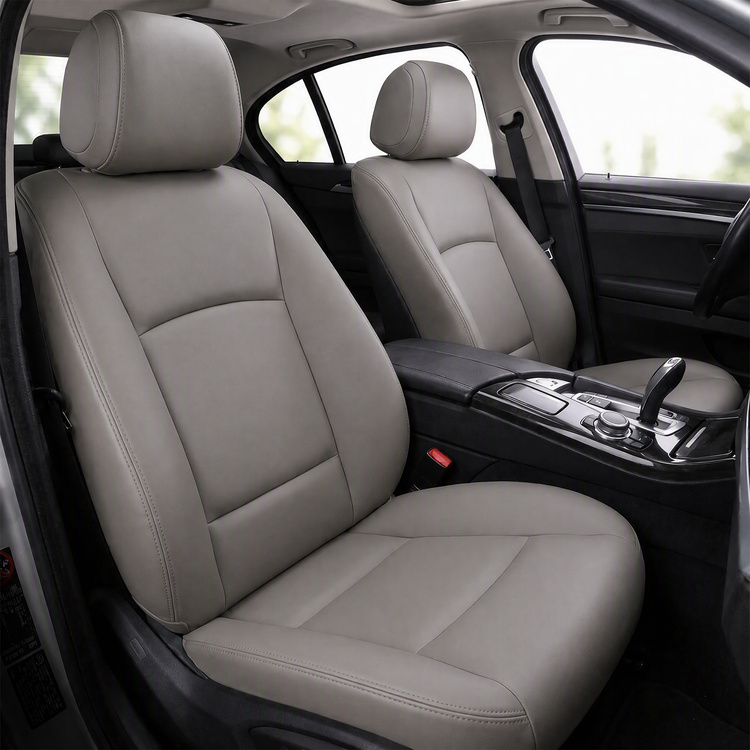
The most important distinction is that these terms describe different aspects of upholstery.
"Nappa" commonly suggests softness and suppleness. "Fine grain" describes a small-scale surface texture. They are not necessarily competing material categories: a soft Nappa-style material can also have a fine-grain finish.
Traditional Nappa is associated with soft animal leather. Automotive usage is less consistent: suppliers may use the term for different hide selections, finishing systems, and surface treatments. Buyers should therefore avoid treating "Nappa" as a complete technical specification.
For synthetic upholstery, the clearer description is "Nappa-style synthetic leather" or "Nappa-look synthetic upholstery." This communicates the intended appearance and feel without implying animal-hide content.
At Tianhai Leather, we recommend identifying the material construction separately from its decorative finish. A useful purchase specification should state the polymer system, backing, thickness, surface finish, and agreed performance requirements.
In this comparison, "fine grain" means a subtle, small-scale surface pattern—not a standardized leather grade.
It should not be confused with "full-grain leather," which refers to animal leather whose original grain surface remains intact. A fine-grain appearance may be natural or created through embossing, depending on the material.
Ask suppliers to clarify whether their fine-grain option is genuine leather, synthetic leather, or another coated construction.
The table below provides a selection framework, not a universal ranking. Actual performance depends on the specific construction and finish.
| Selection factor | Soft Nappa-style upholstery | Fine-grain upholstery |
|---|---|---|
| Main design priority | Supple hand feel and a smooth, restrained appearance | A subtle, closely spaced surface texture |
| Luxury expression | Soft-touch, lounge-like positioning | Precise, visually controlled positioning |
| Surface consistency | Depends on construction and finishing | Depends on grain control and finishing |
| Abrasion resistance | Must be tested | Must be tested |
| Cleaning performance | Depends on coating and approved cleaners | Depends on coating, texture, and approved cleaners |
| Ventilated-seat suitability | Requires assembly evaluation | Requires assembly evaluation |
| Best selection approach | Validate softness alongside durability | Validate texture alongside durability |
Our practical recommendation is to shortlist both appearances, then compare them against the same seat design and acceptance criteria.
A sample that wins on a desk may not win once stitched, stretched, perforated, and installed.
A soft surface can create an attractive first impression. However, upholstery also needs to behave predictably over foam, around curved bolsters, and beside stitched seams.
During development, evaluate:
- Surface touch and compressibility.
- Stretch and recovery.
- Wrinkling after repeated loading.
- Seam appearance on curved panels.
- Compatibility with the intended backing and lamination.
We would not select the softest sample automatically. We would select the sample that delivers the desired touch while maintaining the required finished-seat appearance.
A fine texture does not automatically make upholstery stronger. Likewise, a smooth Nappa-style finish does not automatically make it fragile.
For coated synthetic materials, evaluate the surface coating, backing, adhesion, and resistance to the relevant wear conditions.
The test method matters. ISO 12947-2 excludes coated fabrics and directs users assessing their coated surfaces toward the ISO 5470 methods. Consequently, an abrasion-cycle claim is incomplete without the applicable method, conditions, and endpoint.
Specification should lead the decision—not an impressive cycle count presented without context.
Touch is only one part of seating comfort. Evaluate the upholstery together with the foam, perforations, backing, and ventilation arrangement.
For ventilated seats, a perforated appearance alone is not sufficient evidence of effective airflow. Confirm performance using the intended material stack and seat configuration.
For appearance approval, inspect samples under both diffuse daylight and directional cabin lighting. A surface that appears refined in a sample book may show unexpected gloss or visual variation across a curved seat.
A premium upholstery specification should translate broad promises into measurable acceptance criteria.
| Requirement | What buyers should request |
|---|---|
| Abrasion | Applicable method, loading, endpoint, and results |
| Repeated flexing | Conditions and assessment of cracking or surface damage |
| Accelerated aging | Temperature, humidity, duration, and post-aging evaluation |
| Color transfer | Method and assessment of staining between surfaces |
| Cleaning resistance | Named cleaners, exposure procedure, and appearance criteria |
| Light and heat exposure | Conditions and acceptable color or surface change |
| Fogging | Method, result, and agreed acceptance requirement |
| VOC emissions | Sampling method, target compounds, and relevant limits |
| Flammability | Applicable market or customer requirement and supporting results |
These are related purchasing concerns, but they are not interchangeable measurements.
ISO 6452 evaluates fogging behavior: substances released from a heated specimen condense on a cooler surface. It does not identify every emitted substance or provide a complete assessment of cabin air quality.
ISO 12219 includes methods for evaluating emissions from vehicle interior materials and components. The selected method must match the specimen and the purpose of the assessment.
Odor requires separate attention. ISO 12219-7 addresses olfactory assessment of automotive interior materials and components. A low-odor impression should not replace emissions testing.
ISO 1419 describes methods for assessing deterioration of coated fabrics through accelerated aging. Such testing supports material evaluation; it should not be translated into a guaranteed service life without a justified correlation.
For purchasing, request the exposure conditions and the condition of the material afterward—not simply a statement that it "passed aging."
At Tianhai Leather, our recommended selection workflow connects appearance decisions with manufacturing requirements.
Record the target vehicle, seat zones, climate exposure, cleaning routine, and expected usage.
A lightly used private vehicle and a frequently cleaned passenger-service vehicle may require different priorities, even when both need premium-looking upholstery.
Compare samples with clearly identified constructions. Record thickness, backing, color, gloss, texture, and intended application.
Otherwise, a comparison presented as "Nappa versus fine grain" may actually compare different coatings, backings, or thicknesses.
Produce a trial covering that includes curves, seams, and any intended perforation.
Check whether the surface stretches evenly, whether the grain remains visually balanced, and whether the finished panel matches the design intent.
Agree on a relevant test sequence and inspect both appearance and function afterward.
Include the cleaners intended for actual use. An upholstery material should be evaluated against the maintenance routine the buyer expects to recommend.
Before bulk supply, retain an approved reference and define acceptable variation.
Include color, gloss, grain appearance, thickness, and other critical attributes. This turns "make it like the sample" into a more controlled purchasing instruction.
For customized automotive upholstery, small-batch development is valuable when it answers specific questions—not simply when it produces more swatches.
Tianhai Leather's small-batch customization offering can support a focused discussion of appearance, touch, backing, and project requirements. Exact availability, minimum quantities, and performance targets should be confirmed for each development.
A useful sample brief includes:
1. Target surface appearance and physical reference.
2. Preferred softness and thickness range.
3. Seat locations and fabrication requirements.
4. Color and gloss expectations.
5. Intended cleaning products.
6. Required test methods and acceptance criteria.
7. Trial quantity and anticipated production demand.
This approach helps buyers avoid approving an attractive material before establishing whether it suits the intended seat.
Tianhai Leather focuses on developing environmentally conscious synthetic leather solutions. For individual products, environmental claims should remain specific and verifiable.
Do not assume that "synthetic," "water-based," "PVC-free," or "recycled" independently proves a lower overall environmental impact.
Ask what each claim covers:
- Does recycled content apply to the backing or the complete material?
- Is the percentage supported by documentation?
- Which substances are restricted?
- Is the claim about manufacturing chemistry, emissions, or material composition?
- What comparison supports any claimed environmental advantage?
Keep environmental attributes separate from automotive suitability. A product still needs the performance evidence required for its intended application.
Choose a soft Nappa-style finish when supple touch and a smooth luxury appearance lead the design brief.
Choose a fine-grain finish when a subtle texture and controlled visual character better suit the interior.
Choose a soft, fine-grain synthetic leather when both qualities are important. These characteristics can coexist.
For either direction, approve the actual construction, not the name alone. Material selection becomes more dependable when appearance, testing, fabrication, and supply requirements are agreed together.
Send Tianhai Leather (Dongguan) Co., Ltd. your target texture, color reference, seat application, trial quantity, and testing requirements.
Request a focused sample comparison and small-batch development discussion. The objective is to identify an upholstery solution that looks right, feels right, and can be evaluated against your project's requirements.
Traditional Nappa refers to animal leather. Synthetic alternatives should be described explicitly as Nappa-style synthetic leather. Ask the supplier to identify composition rather than relying on the product name. [autoguide]
No. Fine grain describes surface texture in this article. Full-grain refers to retention of the animal hide's original grain surface. The terms describe different characteristics. [leathernaturally]
Neither name establishes durability. Compare the exact materials using applicable abrasion, aging, cleaning, and other project-specific tests. For coated fabrics, confirm that the abrasion method is appropriate to the coated surface. [iso]
It may be suitable, but approval should depend on the intended perforation, backing, lamination, and complete seat configuration. Request an assembly trial rather than approving ventilation suitability from appearance alone.
No. Odor assessment and chemical emissions analysis serve different purposes. Request relevant emissions testing and, where needed, a separate odor assessment. [iso]
Follow the material supplier's approved cleaning instructions. During development, identify permitted products and validate their effects on the actual finish. Avoid assuming that a cleaner intended for genuine leather is suitable for every synthetic surface.
Provide the application, desired finish, color reference, thickness requirements, backing preference, sample quantity, forecast volume, and required tests. Identify any must-have environmental attributes separately.
- AutoGuide, "What Is Nappa Leather?" — automotive usage and the relationship between Nappa, grain, and finishing. [autoguide]
- CarExpert, "Leather, and Why Not All Animals Are Equal" — variability in automotive Nappa terminology. [carexpert.com]
- Hydes Leather, "FAQ" — distinctions between traditional Nappa and automotive industry usage. [hydesleather]
- Leather Naturally, "Modern Cow Leather Processing," Part Three — full-grain, corrected-grain, and finishing terminology. [leathernaturally]
- ISO, "ISO 12947-2:2016: Textiles—Determination of the Abrasion Resistance of Fabrics by the Martindale Method—Part 2" — scope exclusion for coated fabrics and reference to ISO 5470. [iso]
- FILK Freiberg Institute, "Testing According to ISO 6452" — automotive fogging evaluation and limitations. [filkfreiberg]
- ISO, "ISO 1419:2019: Rubber- or Plastics-Coated Fabrics—Accelerated-Ageing Tests" — coated-fabric aging assessment. [iso]
- ISO, "ISO 12219-2:2012: Interior Air of Road Vehicles—Part 2" — sampling-bag screening of emissions from interior materials and parts. [iso]
- ISO, "ISO 12219-4:2013: Interior Air of Road Vehicles—Part 4" — small-chamber emissions testing. [iso]
- ISO, "ISO 12219-7:2017: Interior Air of Road Vehicles—Part 7" — olfactory determination for automotive interior materials and components. [iso]
Hot Tags: China, Global, OEM, private label, manufacturers, factory, suppliers, manufacturing company
