


Phone:
+86 138 0927 7026


Views: 267 Author: Tianhai Leather Publish Time: 2026-10-29 Origin: Site


Content Menu
● What Is Fabric Similar to Leather?
>> Leather-Look Fabric Versus Genuine Leather
● Why Start With Tianhai Leather?
● Main Types of Fabric Similar to Leather
● How to Choose Leather-Look Fabric by Application
>> Automotive Interiors: Evaluate the Complete Requirement
>> Marine and Yacht Upholstery: Define the Exposure
>> Furniture: Balance Appearance With Maintenance
>> Footwear and Bags: Test Manufacturing Compatibility
● Beyond Abrasion: A Practical Material Testing Framework
>> Do Not Convert Laboratory Weeks Directly Into Years
● How to Run a Small-Batch Customization Project
>> Step 1: Define the Finished Product
>> Step 2: Separate Essential Requirements From Preferences
>> Step 3: Develop and Review Samples
>> Step 4: Confirm the Production Standard
>> Step 5: Confirm Commercial Details
● Environmental Claims: Ask for Specific Evidence
● A Procurement Brief That Produces Better Quotations
>> What fabric is most similar to leather?
>> Is microfiber leather better than PU leather?
>> Is faux leather waterproof?
>> Why does some synthetic leather peel?
>> Can Tianhai Leather support small custom orders?
>> Is vegan leather environmentally friendly?
● Discuss Your Leather-Look Material Project With Tianhai Leather
At Tianhai Leather (Dongguan) Co., Ltd., we help businesses develop fabric similar to leather for automotive interiors, yachts, furniture, footwear, and bags. Our focus combines synthetic leather research, manufacturing, and small-batch customization, helping buyers translate design ideas into practical material specifications.
Choosing a leather alternative involves more than matching a grain pattern. A beautiful sample can still be unsuitable for a humid environment, a tightly stitched shoe upper, or seating exposed to frequent cleaning.
Our approach starts with the finished product: where it will be used, how it will be manufactured, and which performance requirements matter most. This guide explains the main material options, the questions buyers should ask, and how to move from initial samples to a controlled production specification.
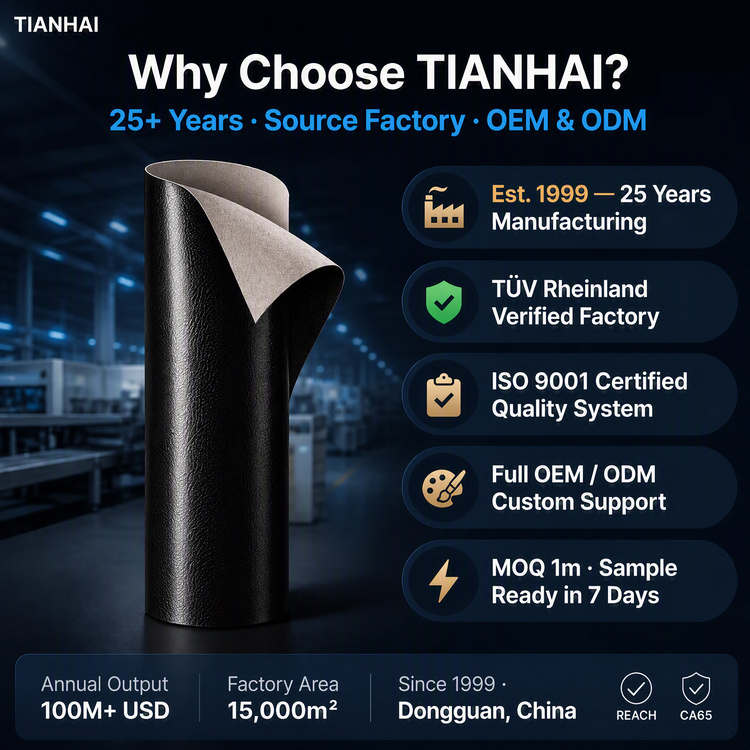
Fabric similar to leather generally means a textile-based material engineered to reproduce some of leather's appearance, texture, or handling characteristics.
Common search terms include faux leather fabric, synthetic leather, leatherette, PU leather, and microfiber leather. These terms overlap, but they do not describe identical constructions.
Many alternatives combine a textile backing with a polymer coating. Others use a microfiber nonwoven structure impregnated with resin. The backing, coating chemistry, surface finish, and manufacturing process all influence the result.
For procurement, the useful question is not simply, "Does it look like leather?"
It is, "Does this construction meet the needs of our product?"
Genuine leather originates from animal hide. Synthetic leather uses manufactured material systems, often involving textiles and polymers.
Neither category guarantees a particular service life. Performance depends on the specific material, finishing system, application, maintenance, and environment.
Likewise, "vegan leather" describes an animal-origin positioning rather than a technical performance grade. Buyers should verify the complete composition instead of treating the label as evidence of durability or environmental superiority.
Tianhai Leather develops and manufactures synthetic leather for businesses seeking application-focused materials and professional customization.
Our capabilities, as described in our company introduction, include:
- Synthetic leather research and product development.
- Manufacturing for multiple end-use sectors.
- Customization for different design and material requirements.
- Small-batch development and supply.
- Quality management supporting consistent material delivery.
We place these services at the center of the sourcing discussion because different products need different solutions.
A furniture brand may prioritize hand feel and cleaning compatibility. A bag manufacturer may care more about edge finishing and shape retention. A yacht project may require closer attention to moisture, sunlight, and applicable fire requirements.
Specific colors, constructions, minimum quantities, lead times, and test documentation should be confirmed for each project. This guide does not imply that every available material meets every application standard.
The following comparison is a starting point, not a universal performance ranking.
| Material | Typical construction | Potential advantages | Questions to resolve |
|---|---|---|---|
| PU-coated fabric | Textile backing with a polyurethane coating | Flexible design options and adjustable surface feel | Hydrolysis resistance, coating adhesion, cleaning compatibility |
| PVC-coated fabric | Textile backing with a polyvinyl chloride coating | Leather-look finishes and potentially practical wipe-clean surfaces | Flexibility, formulation, temperature behavior, restricted substances |
| Microfiber leather | Fine-fiber nonwoven structure combined with resin | Leather-like body and useful cutting or processing characteristics | Actual composition, tear strength, flexing, finishing compatibility |
| Synthetic suede | Fine-fiber material with a suede-like surface | Soft touch and a low-gloss appearance | Stain behavior, color transfer, cleaning instructions |
PU leather fabric is a broad category. Two materials carrying this name can differ substantially in backing, resin chemistry, thickness, and protective finish.
Ask suppliers to identify the construction and provide relevant test information. A soft touch alone does not establish resistance to humid aging or repeated cleaning.
Microfiber leather uses a fine-fiber structure rather than relying solely on a conventional woven or knitted backing.
Some constructions are designed to resemble aspects of leather's three-dimensional fiber network. This can support leather-like handling and processing, but results remain product-specific.
For shoes and bags, evaluate cutting, stitching, skiving, folding, and edge finishing on the actual production equipment.
Automotive projects may involve requirements for appearance, abrasion, light exposure, emissions, fogging, flammability, and cleaning.
Start with the vehicle manufacturer's or customer's specification. A material described as "automotive grade" should not be accepted without identifying the relevant requirements and supporting documentation.
Color should also be reviewed under the lighting conditions used for approval.
An interior cabin cushion and an exposed deck seat face different conditions.
For marine upholstery fabric similar to leather, clarify:
- Indoor or outdoor installation.
- Expected sunlight and moisture exposure.
- Contact with sunscreen, saltwater, or cleaning products.
- Cushion construction and drainage.
- Applicable vessel and fire-safety requirements.
Where relevant, marine fire evaluation may involve the upholstery assembly, not merely an isolated surface swatch.
For residential and commercial furniture, compare surface feel, abrasion performance, seam behavior, stain resistance, and maintenance needs.
Ask how the material responds to the actual cleaning products used by the customer. Do not assume a disinfectant approved for one upholstery brand is suitable for another.
For footwear, assess repeated bending, seam strength, thickness consistency, and compatibility with adhesives and lining materials.
For bags, examine body, fold recovery, edge paint adhesion, stitching appearance, and color transfer.
A flat swatch cannot reveal every issue. A stitched prototype provides a more useful decision point.
One common sourcing mistake is selecting material mainly by its abrasion number.
Abrasion testing is valuable, but it cannot answer every durability question. A material may resist rubbing yet perform poorly under humid aging, repeated folding, or incompatible cleaners.
Use a test plan linked to the expected failure risks.
| Evaluation | What it helps assess | What to request |
|---|---|---|
| Abrasion | Surface wear under specified rubbing conditions | Method, load, endpoint, and result |
| Hydrolysis or humid aging | Resistance to moisture-related degradation | Temperature, humidity, duration, and assessment criteria |
| Flexing | Behavior under repeated bending | Method, cycle count, and observed damage |
| Coating adhesion | Bonding between material layers | Test method and measured result |
| Colorfastness to rubbing | Potential color transfer | Separate dry and wet results |
| Cleaning compatibility | Response to intended maintenance products | Cleaner, concentration, contact time, and procedure |
Accelerated aging helps compare materials under defined conditions. It is not a universal calendar-life prediction.
Likewise, abrasion results from different methods should not be compared as if the numbers were interchangeable.
Review the method and acceptance criteria before treating a headline figure as proof of suitability.
At Tianhai Leather, small-batch customization is part of our service positioning. Buyers can make development more efficient by preparing a clear brief before requesting samples.
Identify the application, destination market, expected environment, and manufacturing process.
Include reference images or an existing material sample when available.
Essential requirements might include a customer specification, thickness tolerance, restricted-substance requirement, or mandatory test.
Preferences might include a softer hand feel, lower gloss, or a particular grain.
This distinction helps avoid approving an attractive sample that misses a critical requirement.
Assess color, texture, backing, thickness, stretch, and surface behavior.
Then make a representative prototype. Review seams, folds, edges, and bonded areas rather than approving only the flat material.
Agree on the approved sample and the written specification.
Record tolerances, test requirements, inspection criteria, packaging, and acceptable variation. Keep an approved reference sample for later comparisons.
Request project-specific minimum quantities, development charges, lead times, and repeat-order conditions.
Small-batch availability does not automatically mean unlimited color changes or identical economics across every construction.
Environmental responsibility matters, but broad labels can hide important differences.
"Eco-friendly," "water-based," "recycled," and "bio-based" should not be treated as interchangeable claims.
For example, a water-based manufacturing process does not automatically mean the finished material is plastic-free, biodegradable, or fully recyclable.
Similarly, recycled content in a backing does not establish the recycled percentage of the entire composite.
Before making a claim, ask:
1. Which component does the claim describe?
2. What percentage is involved?
3. How was that percentage calculated or verified?
4. Does the evidence apply to this exact product?
5. What limitations need to be communicated?
Our environmental positioning should be supported by the documentation available for the selected material, not extended into unsupported product-wide guarantees.
Instead of requesting "your best leather alternative," send suppliers a structured brief.
Include:
- Product and intended use.
- Target market and customer requirements.
- Reference material or appearance images.
- Thickness, width, backing, and stretch preferences.
- Required tests and acceptance criteria.
- Expected order quantity and reorder frequency.
- Custom color or texture requirements.
- Intended cleaning procedure.
- Prototype and production timeline.
This allows quotations to be compared on a more consistent basis.
The lowest price per meter is not necessarily the lowest production cost. Cutting yield, usable width, defect allowances, processing difficulty, and replacement risk can affect the final economics.
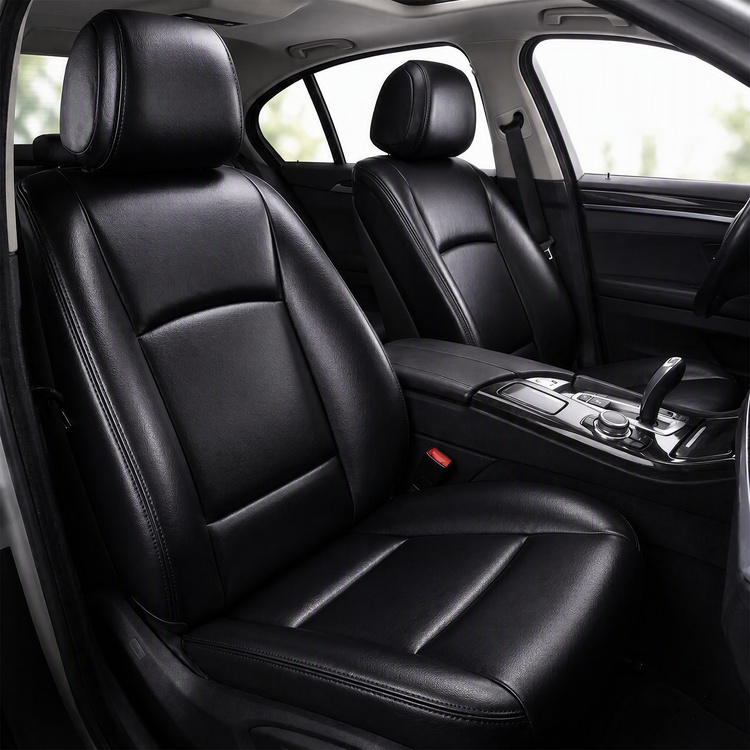
Microfiber leather and selected PU-coated fabrics can reproduce different aspects of leather's appearance and feel. The closest match depends on whether you prioritize grain, softness, structure, stretch, or manufacturing behavior.
The categories overlap because microfiber leather can contain polyurethane. Compare the actual constructions and test results rather than assuming the names establish a quality hierarchy.
Some coated surfaces resist liquid penetration, but finished-product performance also depends on seams, perforations, edges, and construction. Do not describe an entire product as waterproof based only on its surface material.
Possible causes include coating degradation, poor interlayer adhesion, environmental exposure, and incompatible maintenance. Identifying the cause requires reviewing the construction, use conditions, and failure pattern.
Small-batch customization is part of our stated service offering. Confirm feasibility, minimum quantity, sample costs, available constructions, and lead time for the specific project.
Not automatically. Animal-free composition does not establish a lower environmental impact. Responsible comparisons need a defined basis and evidence covering relevant materials and processes.
Send Tianhai Leather (Dongguan) Co., Ltd. your application, reference sample, target quantity, and performance requirements.
We can use that brief to discuss material development, sampling, and small-batch customization. Confirm the appropriate construction, documentation, and production specification before placing an order.
1. Tianhai Leather (Dongguan) Co., Ltd.
2. Google Search Central — [Creating Helpful, Reliable, People-First Content]。
3. Kuraray — [How CLARINO™ Differs from General Synthetic Leather]。
4. Ultrafabrics — [Ultraleather® Tottori Technical Specification]。
5. Ultrafabrics — [Cleaning Instructions and Disinfectants]。
6. International Maritime Organization — [2010 FTP Code, Resolution MSC.307(88)].pdf)。
7. U.S. Federal Trade Commission — [Environmental Claims: Summary of the Green Guides]。
Hot Tags: China, Global, OEM, private label, manufacturers, factory, suppliers, manufacturing company
