


Phone:
+86 138 0927 7026


Views: 245 Author: Tianhai Leather Publish Time: 2026-09-22 Origin: Tianhai Leather


Content Menu
● Why the Material Decision Matters in Automotive Upholstery
● PU Leather vs Genuine Leather: Core Differences
● Why PU Leather Performs Better in High-Volume Programs
>> Consistent Quality Across Large Production Runs
>> Better Material Utilization and Lower Cutting Waste
>> Broader Design and Customization Options
● Where Genuine Leather Still Has an Advantage
>> Natural Character and Premium Storytelling
>> Breathability and Natural Feel
● The Most Important Distinction: Standard PU vs Automotive-Grade PU
>> Questions Buyers Should Ask
● Durability: What OEM Buyers Should Evaluate
>> Key Automotive Upholstery Performance Areas
● Total Cost of Ownership: Look Beyond Material Price
>> Genuine Leather Can Add Costs Through
>> PU Leather Can Create Value Through
● Sustainability and Cabin-Air-Quality Considerations
● Expert Sourcing Framework for Automotive PU Leather
>> Step 1: Define the Vehicle and Component
>> Step 2: Specify the Desired Surface Experience
>> Step 3: Align the Performance Package
>> Step 4: Validate with Samples and Testing
>> Step 5: Confirm Mass-Production Control
● Choosing the Right Material for Your Program
● Partner With Tianhai Leather for Automotive PU Upholstery
>> Is PU leather suitable for automotive seats?
>> Is PU leather cheaper than genuine leather for car interiors?
>> Does PU leather last as long as genuine leather in a car?
>> Which is better for EV interiors: PU leather or genuine leather?
>> Can automotive PU leather be customized?
>> What should I ask an automotive PU leather supplier before ordering?
For high-volume automotive upholstery, automotive-grade PU leather is often the more practical and scalable choice than genuine leather—provided it is engineered for the vehicle's climate, seating zone, performance specification, and regulatory requirements. At Tianhai Leather (Dongguan) Co., Ltd., we combine more than two decades of synthetic-leather manufacturing experience with dedicated automotive PU microfiber leather development to help OEMs, Tier 1 suppliers, and upholstery converters balance appearance, durability, consistency, cost control, and production efficiency.
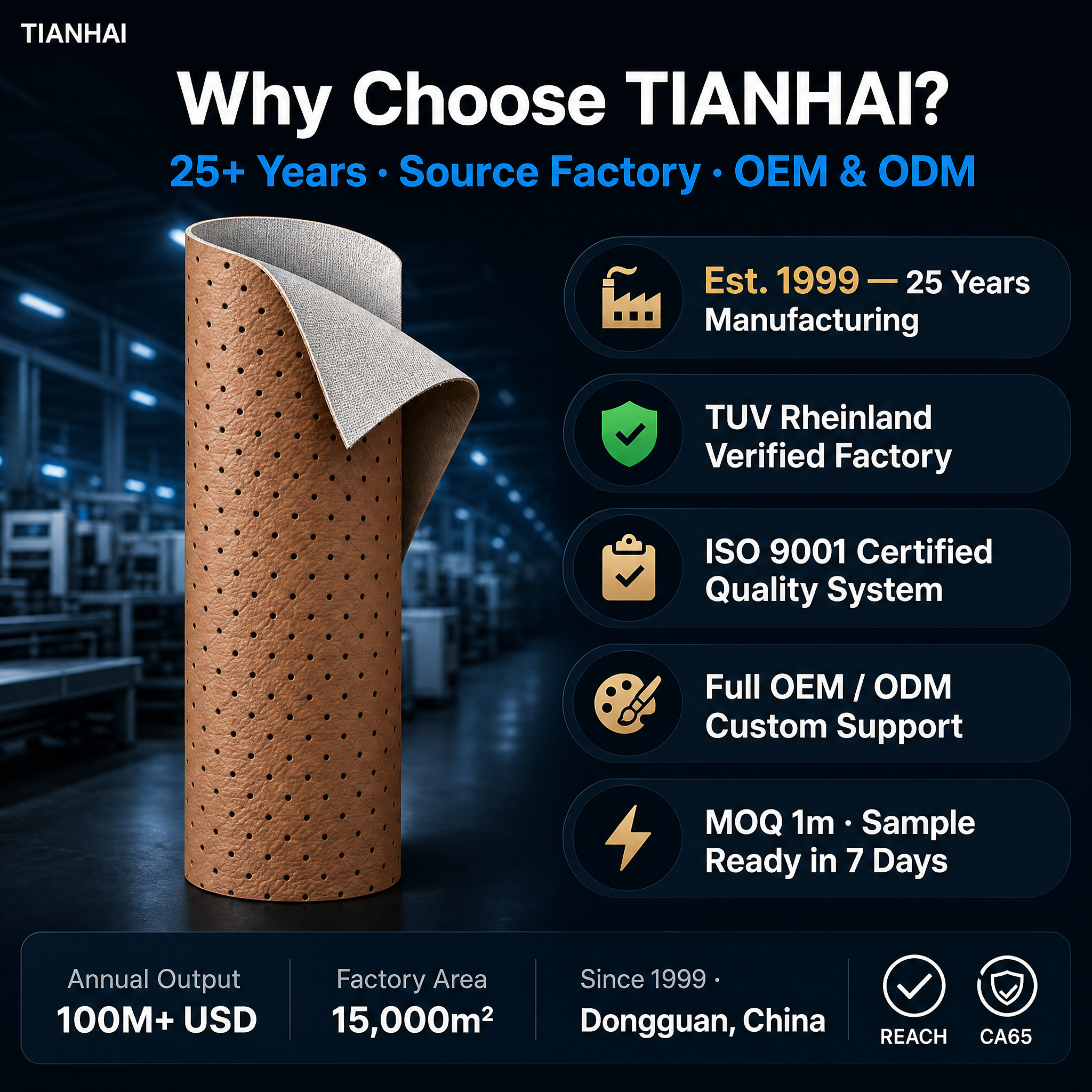
Established in 1998, Tianhai Leather is among the early Chinese manufacturers to develop automotive-grade PU microfiber leather. With four production lines in Dongguan and monthly capacity of approximately 320,000 meters, we support large-scale automotive upholstery programs with custom colors, grains, backing constructions, thicknesses, and functional performance requirements. For buyers evaluating PU leather vs genuine leather for automotive seats, the key question is not simply which material looks more premium. It is which material can deliver repeatable quality over thousands—or millions—of vehicles.

Automotive upholstery operates in a demanding environment. A seat cover or door-trim surface must survive repeated entry and exit, body oils, sunlight, temperature swings, humidity, cleaning chemicals, abrasion, color matching requirements, and long vehicle service cycles.
For high-volume vehicle programs, material selection also affects:
- Supply continuity
- Per-vehicle cost
- Production yield
- Cutting and sewing efficiency
- Color and grain consistency
- Vehicle interior VOC and odor targets
- Waste and defect rates
- Brand positioning
- Compliance documentation
Genuine leather remains highly valued in luxury applications because it is natural, breathable, and visually distinctive. However, its natural variability makes it more difficult to standardize in mass production. Automotive PU leather, especially high-performance PU microfiber leather, is engineered to provide a leather-like surface while offering more predictable dimensions, color, grain, and processability.
For many mainstream, premium-volume, and EV interior programs, that predictability is decisive.
| Factor | Automotive PU Leather | Genuine Leather |
|---|---|---|
| Raw material source | Polyurethane surface with textile, microfiber, or other engineered backing | Animal hide processed through tanning and finishing |
| Appearance consistency | Highly consistent color, grain, thickness, and pattern | Natural variation in grain, scars, wrinkles, and shade |
| Production scalability | Suitable for continuous high-volume roll production | Limited by hide supply, hide size, and usable cutting area |
| Design flexibility | Wide range of grains, colors, embossing, perforation, and backing options | More limited by the original hide and finishing process |
| Cost predictability | Usually easier to budget and control for large programs | More exposed to hide availability, grade variation, and waste |
| Cutting efficiency | High due to uniform width and repeatable surface quality | Lower due to natural defects and irregular hide shapes |
| Maintenance | Generally easy to clean with appropriate automotive-care products | Requires careful maintenance to preserve surface condition |
| Luxury perception | Can be engineered to look and feel premium | Strong heritage and luxury association |
| Sustainability profile | Depends on chemistry, backing, production route, and end-of-life design | Depends on livestock, tanning process, water use, chemicals, and traceability |
The comparison is not a simple "synthetic versus natural" debate. Automotive buyers should assess a material's full performance package, including test data, manufacturing consistency, indoor-air-quality requirements, climate durability, and total cost of ownership.
One of the biggest challenges with genuine leather is natural variation. No two hides are identical. Differences in scars, stretch marks, grain, thickness, and color can create sorting requirements, cutting loss, and visual inconsistency between seat sets.
For a limited-edition luxury model, those natural variations may be part of the appeal. For a high-volume vehicle platform, they can complicate manufacturing.
Automotive PU leather is produced in rolls with controlled specifications. This helps manufacturers achieve:
- More uniform cutting layouts
- More stable sewing and wrapping performance
- Better matching between seats, door panels, and armrests
- More predictable material consumption
- Lower risk of visible variation between vehicles
- Faster scale-up from prototype to mass production
At Tianhai Leather, we understand that automotive interior materials must perform consistently beyond the sample stage. A development sample may look excellent, but the real test is whether the same color, grain, hand feel, and physical performance can be maintained across a long production cycle.
Genuine leather hides are irregular in shape and contain natural marks or lower-grade areas. Upholstery manufacturers must avoid defects in visible zones, which reduces usable yield.
PU leather is supplied in continuous rolls with standardized widths and engineered surface consistency. This can improve cutting efficiency, especially for seat facings, bolsters, headrests, door inserts, consoles, and trim-wrapped components.
For high-volume programs, even small yield improvements can have a major commercial effect. If a vehicle manufacturer produces hundreds of thousands of vehicles annually, saving a small amount of material per vehicle can reduce total material usage substantially.
Automotive brands increasingly use interior design to differentiate vehicles. This is particularly important in EVs, where consumers often judge the cabin as a major part of the ownership experience.
PU leather provides broad design freedom, including:
- Fine grain, nappa-style grain, litchi grain, carbon-fiber patterns, and custom embossing
- Matte, semi-matte, or gloss surface effects
- Solid, two-tone, and contrast-color programs
- Custom thickness and softness
- Perforation compatibility for ventilated seats
- Foam-backed constructions for seat comfort
- Reinforced backing for high-stress zones
- Custom hand feel for luxury, sporty, or technical interiors
Tianhai Leather offers OEM/ODM customization support so buyers can develop materials aligned with brand identity, component requirements, and manufacturing processes. This is valuable when a design team wants a distinctive appearance without accepting the supply limitations of natural hides.
Genuine leather is not obsolete. It remains a compelling option when the product strategy emphasizes heritage, natural material storytelling, exclusivity, or ultra-luxury craftsmanship.
Genuine leather can develop a distinctive patina over time. Its pores, grain variation, and natural characteristics can support a premium narrative that is difficult to reproduce exactly with a synthetic material.
This matters most when:
- The vehicle is positioned as a luxury flagship
- The brand emphasizes traditional craftsmanship
- The production volume is relatively limited
- Buyers expect natural leather as a visible status feature
- The interior program has enough budget for hide selection and quality sorting
Well-finished leather can offer a natural tactile experience and breathability. However, it is important to evaluate the final automotive material rather than the raw hide alone. Automotive leather normally receives coatings, pigments, protective finishes, and treatments that affect touch, breathability, cleanability, and appearance.
For that reason, vehicle manufacturers should compare finished materials under the same use conditions—not just compare a raw hide with a PU sample.
A common sourcing mistake is treating all PU leather as the same product. It is not.
Low-cost PU designed for bags, shoes, furniture, or fashion accessories may not withstand automotive heat, humidity, UV exposure, repeated abrasion, or cabin odor requirements. In contrast, automotive-grade PU leather is engineered for specific vehicle interior conditions.
A qualified supplier should help define the right construction for the specific application.
Before approving PU leather for automotive upholstery, ask the supplier:
1. What is the recommended application: seat, door panel, armrest, steering-wheel wrap, dashboard, or headrest?
2. What abrasion performance can the material achieve under the required test method?
3. How does it perform after heat aging and humidity exposure?
4. Does the surface resist UV fading, cracking, hydrolysis, and plasticizer migration?
5. Can the material meet the target VOC and odor requirements?
6. What is the color-match tolerance from lot to lot?
7. Is the backing designed for sewing, lamination, vacuum forming, wrapping, or perforation?
8. What traceability and batch-control documentation are available?
9. Can the supplier sustain production volume through the program lifecycle?
10. Can custom colors and grains be reproduced consistently after initial approval?
The right material is not simply "PU leather." It is a defined automotive upholstery system: surface chemistry, foam or textile backing, thickness, grain, color, finish, and performance targets working together.
Durability should be evaluated by application zone, not by appearance alone.
A seat bolster experiences repeated friction as drivers enter and exit. A steering-wheel cover faces oils, sweat, hand abrasion, heat, and UV exposure. A door insert may need excellent visual stability but face less mechanical wear. A dashboard material needs strong heat and UV resistance, while an armrest requires softness and resistance to repeated skin contact.
| Performance Area | Why It Matters | What Buyers Should Confirm |
|---|---|---|
| Abrasion resistance | Prevents surface wear in seats, bolsters, armrests, and steering-wheel areas | Test method, load, cycles, visual grading, and post-test surface condition |
| Hydrolysis resistance | Protects PU in humid and hot climates | Test conditions, duration, peeling, cracking, and adhesion results |
| UV resistance | Reduces fading, yellowing, and embrittlement | Accelerated weathering method and color-change rating |
| Heat and cold resistance | Ensures stability in extreme vehicle environments | Performance after high/low-temperature aging |
| Flex resistance | Prevents cracking in repeatedly bent areas | Flex-test results before and after aging |
| Peel strength | Helps maintain surface-to-backing adhesion | Initial and aged peel-strength data |
| VOC and odor | Supports cabin-air-quality targets | Test protocol and material compliance documentation |
| Stain and chemical resistance | Helps withstand sunscreen, sweat, cosmetics, cleaners, and spills | Approved cleaning agents and test results |
For premium PU leather, material engineering matters more than a basic visual comparison. High-performance formulations, properly selected backing materials, and a controlled manufacturing process are critical to long-term reliability.
Genuine leather may appear attractive from a branding perspective, but the purchase price per square meter is only one part of the equation. For high-volume automotive upholstery, buyers should calculate the total conversion cost.
- Hide sorting and grading
- Lower cutting yield
- More manual inspection
- Shade variation management
- Larger inventory buffers
- More complicated nesting and cutting
- Potential supply volatility
- Higher rejection risk when visual matching is strict
- Roll-to-roll dimensional consistency
- Predictable usable yield
- Controlled color and grain matching
- Easier automation
- More stable planning for high-volume orders
- Simplified material handling
- Faster design iteration for new colors and textures
The lowest-priced material is not always the lowest-cost option after cutting, sewing, scrap, inspection, rework, and warranty exposure are included.
Imagine a seat program requiring a light beige upholstery surface. Genuine leather may show natural shade variation between hides, requiring additional sorting to prevent noticeable mismatch between front seats and rear seats. A color-controlled automotive PU leather can be produced to a defined visual target across multiple rolls and lots, making matching more predictable during vehicle assembly.
For large automotive programs, that control can reduce operational friction as much as it improves aesthetics.
Automotive materials are increasingly evaluated for more than appearance and mechanical performance. OEMs and consumers care about interior odor, emissions, chemical compliance, responsible sourcing, recycled content, and material lifecycle planning.
Neither genuine leather nor PU leather is automatically "sustainable" by default.
Genuine leather involves livestock supply chains, tanning, water use, chemical processing, and traceability questions. PU leather relies on polymer chemistry and textile backings, so its environmental profile depends on raw materials, solvent use, manufacturing efficiency, recycled content, and end-of-life design.
For automotive buyers, a more useful approach is to request transparent documentation for:
- Restricted-substance compliance
- VOC and odor testing
- Production process information
- Solvent-free or water-based options where appropriate
- Recycled or bio-based content, where verified
- Material composition and backing details
- Waste-reduction measures
- Quality-control and traceability procedures
At Tianhai Leather, we recommend specifying sustainability and indoor-air-quality expectations at the beginning of the material-development process—not after color and grain have already been approved. This prevents costly redesigns later in the program.
From an automotive material-supplier perspective, the best results come when the buyer provides a complete application brief rather than requesting a generic "car seat PU leather."
Clarify:
- Vehicle class: entry-level, mainstream, premium, luxury, commercial vehicle, or EV
- Component: seat, headrest, door panel, armrest, dashboard, steering wheel, or console
- Intended market and climate
- Annual production volume
- Target vehicle lifetime
- Safety, regulatory, and OEM test requirements
Discuss:
- Grain and visual style
- Gloss level
- Hand feel
- Softness
- Stretch and recovery
- Thickness
- Perforation requirements
- Color target and color-matching tolerance
Select the right PU system and backing construction based on abrasion, flexing, heat, humidity, UV exposure, and cleaning requirements.
Do not approve material solely from a swatch card. Evaluate prototype samples under actual converting conditions, including cutting, sewing, lamination, wrapping, perforation, and assembly.
Before nomination, confirm:
- Production-line capacity
- Lot consistency procedures
- Color-control process
- Quality inspection standards
- Packaging method
- Lead time
- Technical support and communication process
Tianhai Leather's four production lines and monthly capacity of approximately 320,000 meters enable us to support both custom development and scalable supply planning for automotive upholstery projects.
Choose automotive PU leather when your priority is:
- High-volume production
- Stable color and grain consistency
- Controlled cutting yield
- Flexible customization
- Efficient processing
- A leather-like premium appearance
- Predictable supply planning
- Broad design freedom across multiple components
Choose genuine leather when your priority is:
- Natural-material storytelling
- Heritage luxury positioning
- Limited-volume premium programs
- Visible natural grain variation
- A traditional leather ownership experience
For many automotive brands, the strongest solution is not necessarily one material used everywhere. A vehicle can use engineered PU leather for high-volume seating and trim applications while reserving genuine leather for selected flagship variants or limited-edition touchpoints.
The right decision depends on the vehicle's price position, expected volume, climate exposure, performance requirements, and brand strategy.
Tianhai Leather (Dongguan) Co., Ltd. helps automotive upholstery buyers move from concept to scalable production. Since 1998, we have focused on synthetic-leather development and manufacturing, including automotive PU microfiber leather solutions for demanding interior applications.
Our capabilities include:
- Automotive PU leather and PU microfiber leather development
- Custom grain, color, thickness, hand feel, and backing options
- OEM/ODM product development support
- Roll-based production for consistent conversion
- Four production lines in Dongguan
- Approximate monthly capacity of 320,000 meters
- Experience serving applications including automotive interiors, upholstery, footwear, bags, and related markets
If you are comparing PU leather vs genuine leather for high-volume automotive upholstery, contact Tianhai Leather to discuss your target application, performance expectations, design direction, and volume forecast. We can help you develop a material specification that is built for manufacturing—not just for an initial sample presentation.
Yes, automotive-grade PU leather can be suitable for vehicle seats when it is engineered for seat use and validated against the required abrasion, flexing, heat, humidity, UV, peeling, VOC, odor, and cleaning-performance requirements. Buyers should avoid assuming that fashion or furniture PU leather is automatically suitable for automotive upholstery.
In many high-volume programs, PU leather can offer a lower and more predictable total cost than genuine leather. The advantage may come not only from material price, but also from better cutting yield, more consistent roll dimensions, reduced sorting, simpler color matching, and improved production efficiency.
The answer depends on material quality, application zone, climate, vehicle use, and maintenance. Standard PU may degrade prematurely under heat and humidity, while properly engineered automotive-grade PU can be designed for demanding long-term service. Buyers should base decisions on verified performance data, not on appearance or generic product descriptions.
PU leather is often well suited to EV interiors because it supports modern design flexibility, repeatable color and texture, efficient high-volume production, and potential low-VOC or alternative-material strategies. Genuine leather may still be selected for luxury EV models where natural-material positioning is central to the brand experience.
Yes. Automotive PU leather can be customized by color, grain, gloss level, thickness, softness, backing, foam lamination, perforation compatibility, and functional requirements. Customization should be aligned with the intended component and manufacturing process.
Ask about the intended application, construction, abrasion resistance, hydrolysis performance, UV stability, heat aging, peel strength, VOC and odor results, color tolerance, available documentation, production capacity, lead time, and quality-control process.
1. Tianhai Leather (Dongguan) Co., Ltd. company profile and automotive microfiber leather product information: [Alibaba company profile]
2. Tianhai Leather (Dongguan) Co., Ltd. OEM/ODM customization overview: [Tianhai Leather Alibaba page]
3. Tianhai Leather automotive microfiber leather information: [Tianhai Leather automotive microfiber leather page]
4. Tianhai Leather industry-news resources for automotive leather materials: [Tianhai Leather industry news]
5. Automotive material comparison and OEM upholstery considerations: [Car Upholstery Materials: Complete Guide for OEM Buyers] [topsunsiliconeleather]
6. Automotive PU leather use cases and customizable interior applications: [DERFLEX Automotive PU Leather] [derflex]
7. Automotive interior leather market direction, including low-VOC materials, lightweight design, and functional integration: [Automotive Interior Leather Industry Research] [sohu]
8. Automotive OEM upholstery performance considerations, including low-VOC and durability positioning: [OEM Automotive Leather Factory] [caiwingleather]
Hot Tags: China, Global, OEM, private label, manufacturers, factory, suppliers, manufacturing company
