


Phone:
+86 138 0927 7026


Views: 228 Author: Tianhai Leather Publish Time: 2026-10-10 Origin: Site


Content Menu
● Smooth PU Leather vs Fine Grain Leather: Understanding the Comparison
>> What Buyers Should Confirm First
● Surface Appearance and Automotive Interior Design
>> Smooth PU Leather for a Clean, Uniform Look
>> Fine-Grain PU Leather for Subtle Texture
● Comparison Table for Automotive Upholstery Buyers
● Automotive Durability: Why Texture Is Not a Performance Rating
>> Assess Abrasion, Flexing, and Surface Integrity Separately
>> Treat Accelerated Aging as Evidence, Not a Lifespan Promise
● Automotive Qualification: Emissions, Fogging, and Flammability
>> VOC and Fogging Are Related but Different
>> Flammability Requires the Correct Material Configuration
● A Practical Qualification Workflow Before Large-Scale Production
>> Step 1: Define the Component and Operating Requirements
>> Step 2: Compare Like-for-Like Candidates
>> Step 3: Build Representative Components
>> Step 4: Test and Review the Proposed Construction
>> Step 5: Establish a Controlled Production Standard
● Large-Scale Consistency: From Approved Sample to Repeatable Supply
>> Control Appearance Across Rolls and Lots
>> Connect Material Inspection to Manufacturing Results
● Cost per Accepted Component: A Better Procurement Metric
● Environmental Claims Buyers Can Verify
● Working with Tianhai Leather on Your Automotive Material Brief
>> 1. Is fine-grain leather always genuine leather?
>> 2. Is smooth PU leather less durable than fine-grain PU leather?
>> 3. Which surface is easier to clean?
>> 4. Can one test report qualify every automotive application?
>> 5. Why use small-batch customization before larger orders?
>> 6. What should buyers send Tianhai Leather first?
● References and Source Transparency
At Tianhai Leather (Dongguan) Co., Ltd., we focus on synthetic leather research, manufacturing, and customization for automotive interiors, yachts, furniture, footwear, and bags. When customers evaluate smooth PU leather vs fine grain leather for large-scale automotive upholstery production, the central question is not simply which surface looks better. It is which material construction supports the required appearance, manufacturing process, and long-term performance.
Our company's approach combines advanced production processes, strict quality management, and small-batch customization. For automotive buyers, small-batch development can help establish a material specification before larger purchasing commitments.
This guide takes a manufacturer-oriented view of the comparison. It explains texture, qualification, production consistency, and purchasing decisions without treating appearance as proof of automotive suitability.
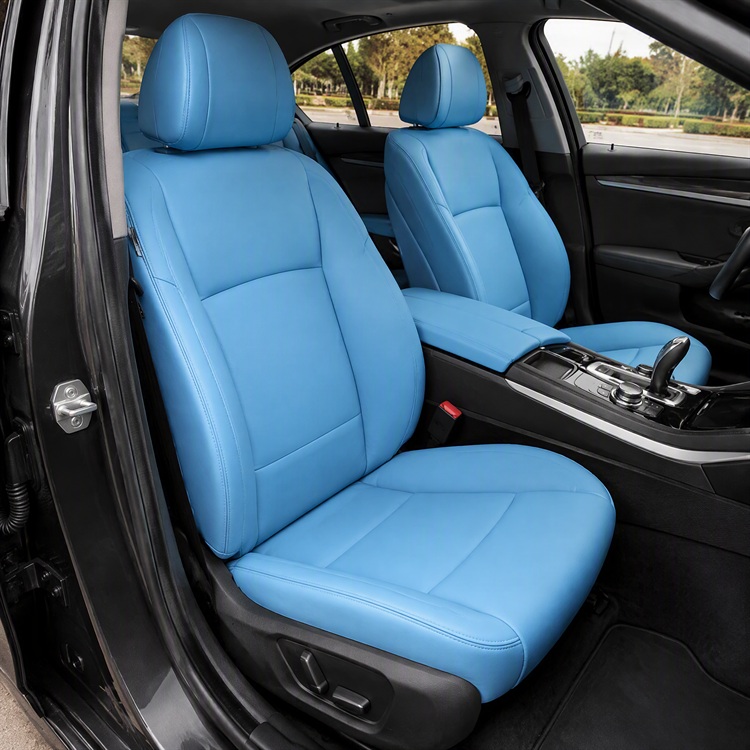
PU describes polyurethane, a material used in synthetic leather coatings. "Smooth" and "fine grain" describe surface appearance.
Smooth PU leather has a relatively even surface with little visible grain. Fine-grain PU leather features a subtle leather-like pattern. Both can belong to the same synthetic leather family.
Fine grain should not be confused with full-grain leather. Full-grain refers to a category of natural leather, while fine grain is often a texture description. Buyers should establish whether a supplier means embossed synthetic leather or genuine animal leather before comparing quotations.
For this article, the comparison is between smooth and fine-grain PU synthetic leather. The useful purchasing principle is construction: evaluate the coating system, backing, finish, and manufacturing controls together—not texture alone.
Ask each supplier to identify:
- Material composition and backing type.
- Surface finish and grain pattern.
- Thickness, usable width, and tolerances.
- Intended automotive component.
- Applicable test methods and acceptance criteria.
- Whether supplied results cover the exact proposed material.
These details make the comparison technically meaningful.
Smooth PU leather suits design briefs seeking uninterrupted surfaces, restrained detailing, and a contemporary appearance. It can create a clear visual contrast with stitching, perforation, and adjacent textured components.
However, smooth does not automatically mean easy to manufacture. Depending on gloss and color, slight waviness, handling marks, or surface inconsistencies may become visually prominent.
Evaluate the material on a finished component rather than relying exclusively on a flat swatch. A surface that looks excellent on a desk may appear different when stretched over foam or viewed under directional cabin lighting.
Fine-grain PU leather offers a more textured visual character while avoiding the strong pattern of heavily embossed surfaces.
A subtle grain may make some minor marks less conspicuous, but this is a visual consideration—not evidence of greater abrasion resistance. Grain definition also needs evaluation after forming, stitching, cleaning, and wear.
The relevant question is whether the selected texture remains acceptable throughout the component's expected use, not whether it looks convincing when new.
| Selection factor | Smooth PU leather | Fine-grain PU leather | Purchasing implication |
|---|---|---|---|
| Visual character | Relatively uninterrupted surface | Subtle patterned surface | Match the interior design brief |
| Surface inspection | Some irregularities may be conspicuous | Texture can alter defect visibility | Inspect under agreed lighting |
| Grain control | Limited grain-related variables | Pattern definition and orientation matter | Establish an approved surface master |
| Cleaning assessment | Evaluate finish and cleaner compatibility | Evaluate finish and soil retention within texture | Test actual cleaning procedures |
| Wear appearance | Scratching or polishing may change appearance | Grain flattening may change appearance | Assess visual change alongside damage |
| Forming behavior | Depends on the material structure | Depends on structure and texture retention | Trial the intended component |
| Automotive qualification | Requires application-specific evidence | Requires application-specific evidence | Do not approve from appearance alone |
Neither surface is universally superior. The correct choice depends on the complete specification and production results.
For automotive PU upholstery, a purchasing decision should separate aesthetic approval from functional approval.
A fine-grain surface can look robust while using a construction unsuitable for the application. A smooth surface can perform well when its formulation and backing meet the requirements.
An abrasion result does not answer every durability question. Buyers should also consider flexing, coating adhesion, seam behavior, and visual changes.
A surface may remain intact but develop an unacceptable glossy patch. Another may preserve its appearance initially but show cracking after repeated deformation.
Specify the test method, exposure conditions, and failure criteria. "High abrasion resistance" is not a complete specification without those details.
Automotive materials may encounter heat and moisture. Aging assessment helps determine how a coated fabric responds to defined exposure conditions.
ISO 1419 describes methods for evaluating deterioration through accelerated aging. However, a laboratory exposure should not be converted automatically into a guaranteed number of service years.
For procurement, request the test conditions and observed outcomes. Look for changes in appearance, adhesion, flexibility, and surface integrity—not merely a headline "pass."
Material qualification should reflect the vehicle program, target market, and component. There is no single "automotive-grade" label that replaces the customer's specification.
Volatile organic compound testing evaluates emissions from materials. VDA 278 uses thermal desorption and analytical measurement to assess volatile and condensable organic emissions.
Fogging concerns material emissions that can condense on cooler surfaces. ISO 6452 addresses fogging characteristics of automotive interior trim materials, including coated fabrics.
A low odor does not prove low emissions. Likewise, a favorable result under one method does not establish compliance with every customer requirement.
Request reports identifying the material, method, sample condition, result, and relevant acceptance limit.
For applicable U.S. automotive interior materials, FMVSS 302 establishes burn-resistance requirements. Its specified procedure includes a maximum flame-spread rate of 102 mm per minute, with additional provisions in the regulation.
Do not interpret this as a blanket certification for every product using a tested surface material.
The relationship between layers matters. Buyers should determine which single material or composite configuration requires testing under the applicable specification. Adhesives, backing, foam, and processing changes may warrant further evaluation.
Tianhai Leather's small-batch customization offering provides a starting point for development. Buyers can use the following workflow to turn an attractive sample into a controlled purchasing specification.
Identify whether the material will be used for seat upholstery, door inserts, armrests, headrests, or decorative trim.
Record the intended manufacturing process, contact conditions, cleaning expectations, and customer test requirements.
Where practical, compare smooth and fine-grain options with similar backing, thickness, color, and performance targets.
Otherwise, an apparent "texture advantage" may actually come from a different coating or substrate.
Trial cutting, stitching, lamination, and forming on the actual production equipment or a representative setup.
Inspect seams, tight curves, perforated areas, and transitions between materials. Record settings and defects rather than relying on general impressions.
Complete the required material tests and any relevant assembly-level assessments.
Keep aesthetic approval and technical approval separate so that a visually preferred option does not bypass qualification.
Approve a reference sample, material specification, inspection plan, and change-control process.
Retain samples from development and production lots. These provide a practical comparison when color, grain, hand feel, or performance questions arise later.
The challenge in large-scale automotive upholstery production is not only making one good sample. It is maintaining an agreed material specification across deliveries.
Define inspection conditions for color, gloss, and grain. Agree on lighting, sample orientation, and the reference against which material is judged.
For fine-grain PU, check pattern definition and any directional effects. For smooth PU, evaluate surface uniformity and finish consistency.
Avoid using "same as the sample" as the entire specification. Translate approval into measurable requirements wherever practical.
Track usable width, visible defects, thickness variation, seam performance, and production scrap.
When a problem occurs, link it to the material lot and process settings. This helps distinguish a material issue from a cutting, sewing, adhesive, or equipment issue.
Supplier and buyer should also agree which changes require notification and reapproval.
The lowest price per meter is not necessarily the lowest production cost.
A useful comparison includes:
- Material consumed per component.
- Cutting waste and unusable areas.
- Rejected or reworked components.
- Additional inspection and handling.
- Qualification and change-management costs.
An illustrative example shows the relationship. Suppose two candidates cost the same per square meter. If one requires 10% more purchased material per accepted component, its material cost per accepted component is also 10% higher.
This is a hypothetical calculation, not Tianhai Leather production data.
Before selecting a surface, conduct a representative trial and compare accepted output. A slightly more expensive material may be commercially preferable if verified yield and process stability offset the purchase-price difference.
Tianhai Leather's supplied company description emphasizes environmentally conscious synthetic leather solutions. For automotive procurement, that objective should be translated into product-specific evidence.
"Synthetic," "PU," "water-based," and "eco-friendly" do not mean the same thing.
Ask what a claim covers: manufacturing chemistry, restricted substances, emissions, recycled content, or another defined attribute. Request supporting documentation and confirm whether it applies to the supplied product.
Where relevant, assess the complete material rather than one layer. A coating claim may not describe the backing, adhesive, or finished assembly.
Clear, limited claims are more useful than broad environmental language that buyers cannot verify.
Tianhai Leather (Dongguan) Co., Ltd. combines synthetic leather development, manufacturing, and customization services across several application sectors.
For automotive projects, begin with a defined technical brief rather than a request for "the best PU leather." Share the intended component, appearance target, processing method, qualification requirements, and expected purchasing volume.
Small-batch customization can support initial comparisons before a broader supply decision. Any move toward volume production should remain subject to confirmed capacity, approved specifications, testing, and agreed delivery arrangements.
Contact Tianhai Leather to discuss smooth and fine-grain PU leather options for your automotive upholstery project. Provide your reference texture, color target, component drawings, required tests, and trial quantity so the discussion can focus on a material that fits your production needs.
No. Fine grain describes texture and may refer to embossed synthetic leather. Confirm composition before purchasing. It is not interchangeable with the term full-grain natural leather.
Not inherently. Durability depends on the complete material construction and qualification results. Texture alone cannot establish abrasion, aging, or flex performance.
There is no universal answer. Compare the finish, texture, staining behavior, and compatibility with approved cleaners using representative samples and a defined cleaning procedure.
No. Reports must be relevant to the proposed material, component configuration, test method, and customer requirements. Material or process changes may require reassessment.
It allows buyers to evaluate appearance and processing with less initial commitment. The trial should still lead to documented specifications and relevant qualification—not sample approval alone.
Send the component application, composition requirements, target color and texture, dimensions, processing details, test specifications, trial quantity, and anticipated demand.
1. Company information supplied by the client: Tianhai Leather (Dongguan) Co., Ltd. company introduction. Used for the company's business scope, development and manufacturing focus, quality-management positioning, and small-batch customization offering. No public company page, verified customer reviews, certifications, or product test reports were supplied.
2. International Organization for Standardization. *ISO 1419:2019 — Rubber- or plastics-coated fabrics — Accelerated-ageing tests.* Supports the discussion of accelerated-aging assessment. [iso]
3. International Organization for Standardization. *ISO 6452:2021 — Rubber- or plastics-coated fabrics — Determination of fogging characteristics of trim materials in the interior of automobiles.* Supports the explanation of automotive fogging testing. [iso]
4. Shimadzu Corporation. *Analysis of VOC and SVOC Emissions from Automotive Interior Materials.* Explains VDA 278 analysis using thermal desorption and GC–MS. [shimadzu]
5. Markes International. *Application Note 141: Analysis of VOC and FOG Emissions from Automotive Interior Materials by Direct Desorption TD–GC–MS in Accordance with VDA 278.* Supports the distinction between volatile and condensable emissions. [markes]
6. Electronic Code of Federal Regulations. *49 CFR § 571.302 — Standard No. 302; Flammability of Interior Materials.* Provides the regulatory basis for the flammability discussion. [ecfr]
7. Google Search Central. *Creating Helpful, Reliable, People-First Content.* Informs the editorial approach: useful comparisons, transparent sourcing, and avoiding unsupported experience or authority claims. E-E-A-T itself is not a specific ranking factor, and this article cannot guarantee search rankings. [developers.google]
The comparison framework, qualification workflow, and cost illustration are editorial analysis—not reported customer outcomes or Tianhai Leather test results.
Hot Tags: China, Global, OEM, private label, manufacturers, factory, suppliers, manufacturing company
