


Phone:
+86 138 0927 7026


Views: 258 Author: Tianhai Leather Publish Time: 2026-10-08 Origin: Site


Content Menu
● What Does Material Consistency Mean in Automotive OEM Production?
● Synthetic Leather vs Genuine Leather: Automotive Production Comparison
● Why Synthetic Leather Often Provides More Predictable Production
>> Repeatable Grain, Color, and Surface Finish
>> Roll Geometry Supports More Predictable Cutting
>> Engineered Construction Can Stabilize Processing Behavior
● Where Genuine Leather Remains a Strong Automotive Choice
● Automotive Consistency Must Include Emissions, Aging, and Safety
● A Practical Five-Step Process for Comparing Automotive Upholstery Materials
>> 1. Translate the Component into Measurable Requirements
>> 2. Compare Multiple Production Lots
>> 3. Run the Actual Manufacturing Process
>> 4. Validate Aged Performance
>> 5. Freeze the Approved Construction
● Small-Batch Customization: Useful for Development, Not a Substitute for Validation
● Environmental Claims Need Evidence, Not Material Labels
● Choosing the More Consistent Material for Your OEM Program
>> Discuss Your Automotive Material Requirements with Tianhai Leather
>> Is synthetic leather always more consistent than genuine leather?
>> Which synthetic leather is best for automotive OEM production?
>> Does uniform thickness guarantee consistent sewing?
>> Can genuine leather achieve reliable color matching?
>> Does passing VDA 278 prove full automotive compliance?
>> Can small-batch samples support an automotive development project?
At Tianhai Leather (Dongguan) Co., Ltd., we focus on synthetic leather research, manufacturing, and customization for automotive interiors, yachts, furniture, footwear, and bags. For automotive buyers, one question deserves particular attention: "Synthetic Leather vs Genuine Leather for Automotive OEM Production: Which Is More Consistent?"
Our answer is straightforward: consistency generally favors well-engineered synthetic leather, particularly for repeatable surface appearance, roll-based cutting, and controlled material construction. However, material category alone does not guarantee production stability. A poorly controlled synthetic material can create more problems than carefully selected automotive-grade genuine leather.
From a manufacturer's perspective, the right comparison is not simply artificial versus natural. It is whether a specific material, supplied through a controlled process, repeatedly meets the requirements of your vehicle program.

Consistency means more than matching an approved color sample.
A material must behave predictably during cutting, sewing, wrapping, lamination, assembly, and service. Buyers should evaluate three connected levels:
- Within-batch consistency: variation across one roll or between hides in one delivery.
- Between-batch consistency: differences between production lots supplied over time.
- Performance consistency: whether appearance and mechanical properties remain acceptable after specified aging and exposure.
A surface may look uniform but stretch differently along two directions. Another may sew well initially but change after heat and humidity exposure.
For automotive OEM production, consistency therefore means repeatable appearance, processing behavior, and tested performance—not merely an attractive showroom sample.
The following comparison describes typical tendencies, not guaranteed results for every product.
| Production factor | Engineered synthetic leather | Automotive-grade genuine leather |
|---|---|---|
| Material format | Commonly supplied in rolls | Supplied as individual hides |
| Surface appearance | Grain and finish can be deliberately repeated | Natural variation may remain despite finishing |
| Thickness control | Construction can be controlled through coating and backing processes | Splitting and finishing improve uniformity, but hide-zone differences remain |
| Cutting layout | Regular roll geometry supports repeatable nesting | Irregular outlines and defects complicate nesting |
| Stretch behavior | Depends on backing, construction, and direction | Depends on hide location and fiber structure |
| Batch matching | Requires formulation and process control | Requires selection, grading, and finishing control |
| Long-term durability | Depends on formulation and complete construction | Depends on tanning, finishing, and leather quality |
| Environmental performance | Requires product-specific evidence | Requires product-specific evidence |
The practical advantage of synthetic leather is that more aspects of its construction can be deliberately specified. Genuine leather offers natural character, but that character also introduces variables that production teams must manage.
Synthetic leather allows manufacturers to reproduce a chosen grain through controlled surface-processing methods. Color, gloss, texture, and coating construction can also be managed against approved references.
This matters when a seat cushion, backrest, headrest, and door insert must appear coordinated.
Still, matching a master sample once is not enough. Manufacturers need defined acceptance criteria, repeatable measurement conditions, and retained production samples.
A useful approval package combines instrumental color measurement with visual assessment under agreed lighting. Texture and gloss deserve separate attention because two materials can have similar color readings yet look different in the cabin.
Regular roll geometry gives cutting teams a repeatable starting point.
Genuine leather hides have irregular outlines, and their usable areas depend on natural markings, defects, and the location of acceptable cutting zones. Synthetic rolls avoid hide-shaped boundaries, although they can still contain coating defects, edge variation, or other unusable areas.
The correct conclusion is not that synthetic leather eliminates waste. It is that roll-based supply can make nesting and material planning more predictable.
Actual yield should always be confirmed using the intended component patterns.
For synthetic leather, the surface layer and backing work together.
Backing selection affects stretch, dimensional stability, and sewing behavior. Surface construction influences feel, wear resistance, and appearance. Changes in either can affect the finished part.
This is why automotive buyers should approve a complete material construction rather than a surface appearance alone.
For example, changing the backing while retaining the same color and grain may alter seam puckering or wrapping behavior. Such changes should trigger review rather than being treated as commercially interchangeable.
Genuine leather is not inherently unsuitable for consistent OEM manufacturing.
Automotive-grade leather can be carefully selected, split, finished, inspected, and assigned to appropriate cutting zones. These controls help manufacturers manage natural variation.
It may remain attractive where the vehicle's positioning emphasizes authentic leather, natural character, or a particular tactile experience.
The trade-off is that manufacturing processes must accommodate the substrate. Hide inspection, grading, zone selection, and cutting decisions become especially important.
From a procurement perspective, the question is whether those additional controls support the program's design intent and commercial targets.
A premium leather program and a highly standardized synthetic upholstery program may both succeed. They simply manage variation differently.
A material that looks repeatable at delivery can still fail during validation or use.
Automotive interior materials may face heat, sunlight, humidity, abrasion, cleaning chemicals, and repeated occupant contact. Relevant evaluations depend on the component and the customer's specification.
A practical validation plan may include:
- Abrasion and surface-wear resistance.
- Flexing and seam-related performance.
- Color transfer under rubbing.
- Heat, humidity, and light exposure.
- Cleaning-agent compatibility.
- Odor and emissions assessment.
- Applicable flammability testing.
VDA 278 evaluates organic emissions from non-metallic automotive materials through thermal-desorption analysis. Fogging assessments address another concern: compounds that can condense on cooler surfaces.
For relevant US vehicle applications, FMVSS No. 302 establishes flammability requirements for specified interior materials.
These are not interchangeable tests. Passing one does not establish compliance with another, and an isolated material result does not automatically validate every laminated assembly.
Buyers should define the applicable methods, specimen construction, conditioning, and acceptance limits before approving production.
Start with the application.
A seat bolster, flat door insert, and wrapped console may need different stretch, surface, and processing characteristics.
Define thickness, usable width, appearance, directional behavior, relevant performance requirements, and assembly conditions. Avoid relying on descriptions such as "premium quality" or "automotive suitable" without measurable criteria.
One excellent sample demonstrates possibility, not repeatability.
Request material from several independent production lots. For rolls, sample different positions across the width and length. For genuine leather, include relevant hide zones.
Compare average results and variation. A supplier consistently near the specification limit may present more risk than one operating comfortably within it.
Laboratory testing should be complemented by production trials.
Cut the intended patterns. Sew representative seams. Evaluate wrapping and lamination where applicable. Inspect appearance after assembly.
Record defects such as puckering, stretching, surface marking, or inconsistent grain orientation.
A material can meet individual test requirements yet prove difficult to process on the intended line.
Evaluate what happens after the exposure conditions specified for the program.
Inspect appearance, adhesion, flexibility, and other relevant properties after conditioning. For polyurethane constructions, include appropriate assessment of resistance to moisture-related degradation.
Do not infer long-term performance from material names alone. "PU," "PVC," and "microfiber" identify broad categories, not complete durability specifications.
Once approved, document the material identity and controlled characteristics.
The agreement should address formulation, backing, surface finish, approved manufacturing route, inspection criteria, and change notification.
Where required, align the documentation with the customer's production-part approval and quality-planning process.
Consistency becomes more credible when there is a documented route from approved sample to repeat production.
Tianhai Leather provides synthetic leather development and customization, including small-batch projects.
For automotive development, this approach can help buyers explore color, grain, feel, backing, and processing requirements before committing to a larger program.
However, prototype approval and production approval are different milestones.
A successful small batch should lead to a defined scale-up plan: preserve the approved construction, assess repeat lots, and confirm that production conditions reproduce the intended result.
Our manufacturer-led approach is to begin with the customer's application and work toward an appropriate material proposal—not to assume that every synthetic leather is suitable for every automotive component.
Existing work in furniture, marine, or other markets can inform development, but it does not replace automotive-specific qualification.
Tianhai's stated development focus includes environmentally conscious synthetic leather solutions. For automotive buyers, that goal should translate into specific, verifiable requirements.
Synthetic leather is not automatically more sustainable because it is non-animal. Genuine leather is not automatically more sustainable because it is natural.
Meaningful comparisons should consider formulation, manufacturing inputs, restricted substances, service life, cutting waste, and end-of-life options.
Where environmental impact is a purchasing priority, request product-specific evidence and comparable life-cycle boundaries.
Claims such as "water-based," "recycled content," or "solvent-free" should describe a verified product characteristic. They should not be used as substitutes for a complete environmental assessment.
The same discipline applies to low-emission claims: specify the test method and result rather than relying on marketing language.
For programs prioritizing repeatable appearance, regular cutting geometry, and controlled construction, qualified synthetic leather often offers the more straightforward route to consistency.
For programs prioritizing authentic natural character, carefully controlled genuine leather can remain the right choice.
In both cases, the strongest evidence comes from repeat-lot data, actual component trials, documented specifications, and controlled changes.
Send Tianhai Leather (Dongguan) Co., Ltd. your component application, target appearance, thickness requirements, assembly process, annual volume, and applicable test specifications.
We can use that brief to discuss a synthetic leather development proposal and small-batch sampling pathway. Final suitability should be established through the testing and approval process required for your automotive program.
No. Engineered synthetic leather generally offers advantages in repeatable appearance and roll geometry, but supplier process control determines actual consistency. Well-controlled automotive leather can outperform poorly controlled synthetic material.
There is no universal best category. Compare the complete construction against the component's appearance, processing, aging, emissions, and safety requirements. Material names alone are insufficient.
No. Backing stability, directional stretch, surface friction, seam design, and machine settings also influence sewing. Validate the intended construction on representative production equipment.
Yes. Selection and controlled finishing can improve matching. Buyers should still evaluate batch variation, texture, gloss, and appearance under agreed lighting conditions.
No. VDA 278 addresses organic emissions characterization. Other requirements may cover odor, fogging, flammability, wear, aging, and component-specific performance.
Yes. They can support appearance selection and initial processing trials. Production approval still requires suitable validation, repeatability evidence, and agreement on controlled specifications.
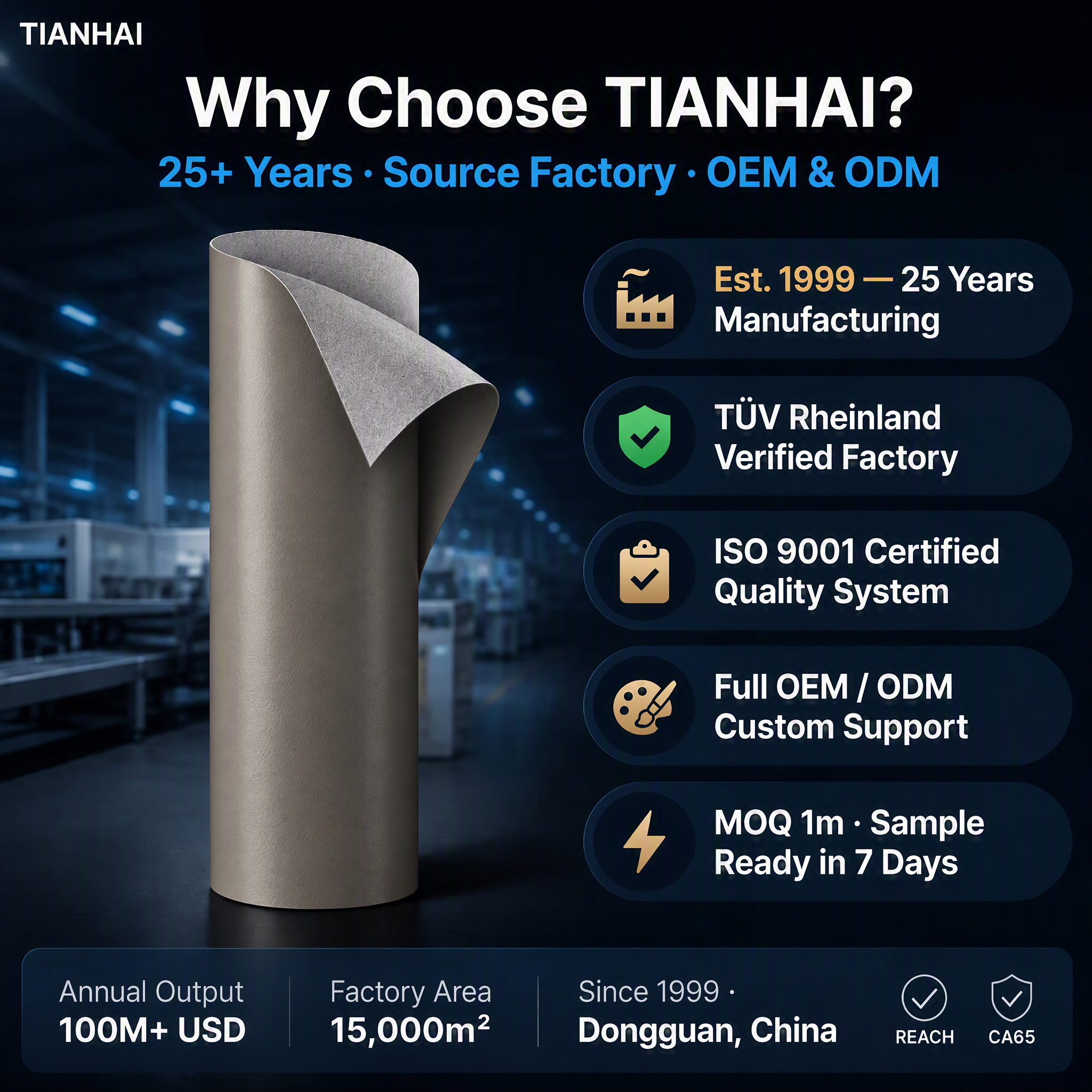
1. Company information supplied for this article — Tianhai Leather (Dongguan) Co., Ltd. Business scope, synthetic leather development, manufacturing, customization, target markets, and small-batch services. No customer reviews or product-specific test data were supplied.
2. Google Search Central — "Creating Helpful, Reliable, People-First Content." Official guidance on helpful content, experience, expertise, authoritativeness, and trust. [developers.google](https://developers.google.com/search/docs/fundamentals/creating-helpful-content)
3. BuyLeatherOnline — "Leather Grades and Quality Guide: How to Evaluate a Hide." Practical discussion of natural markings, thickness variation, irregular hide geometry, and usable cutting area. Its illustrative yield percentages have not been adopted as automotive benchmarks. [buyleatheronline](https://buyleatheronline.com/en/blog/leather-grades-quality-guide-n112)
4. Markes International — "Standard Method: VDA 278." Explanation of thermal-desorption analysis for VOC and FOG emissions from automotive interior materials. [markes](https://markes.com/standard-methods/vda-278)
5. FILK Test Laboratory — "VDA (Automotive-Interior)." Laboratory overview covering automotive imitation-leather testing, emissions, odor, and fogging methods. [filkfreiberg](https://www.filkfreiberg.de/en/testing-certification/accredited-test-laboratory/tests-by-publisher/vda)
6. US National Highway Traffic Safety Administration — "Interpretation ID: 09-004766 302." Official explanation of FMVSS No. 302 applicability to specified vehicle interior components and material locations. [nhtsa](https://www.nhtsa.gov/interpretations/09-004766-302)
7. Leather Working Group — "Environmental Impact." Industry organization's explanation of environmental assessment, audit standards, and leather life-cycle assessment work. [leatherworkinggroup](https://www.leatherworkinggroup.com/our-impact/environmental-impact/)
Hot Tags: China, Global, OEM, private label, manufacturers, factory, suppliers, manufacturing company
